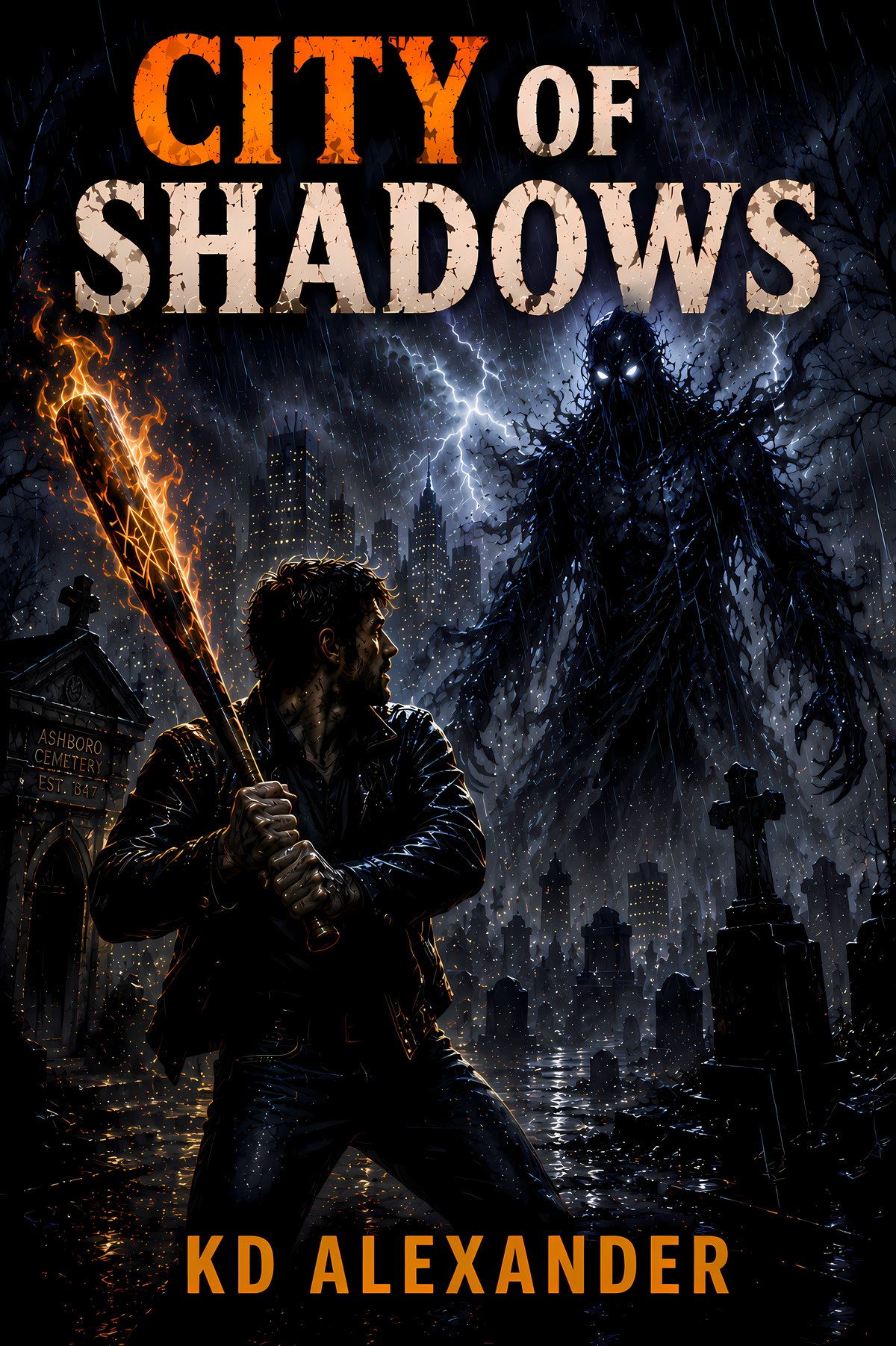
City of Shadows
Urban Fantasy / Occult Cop Thriller
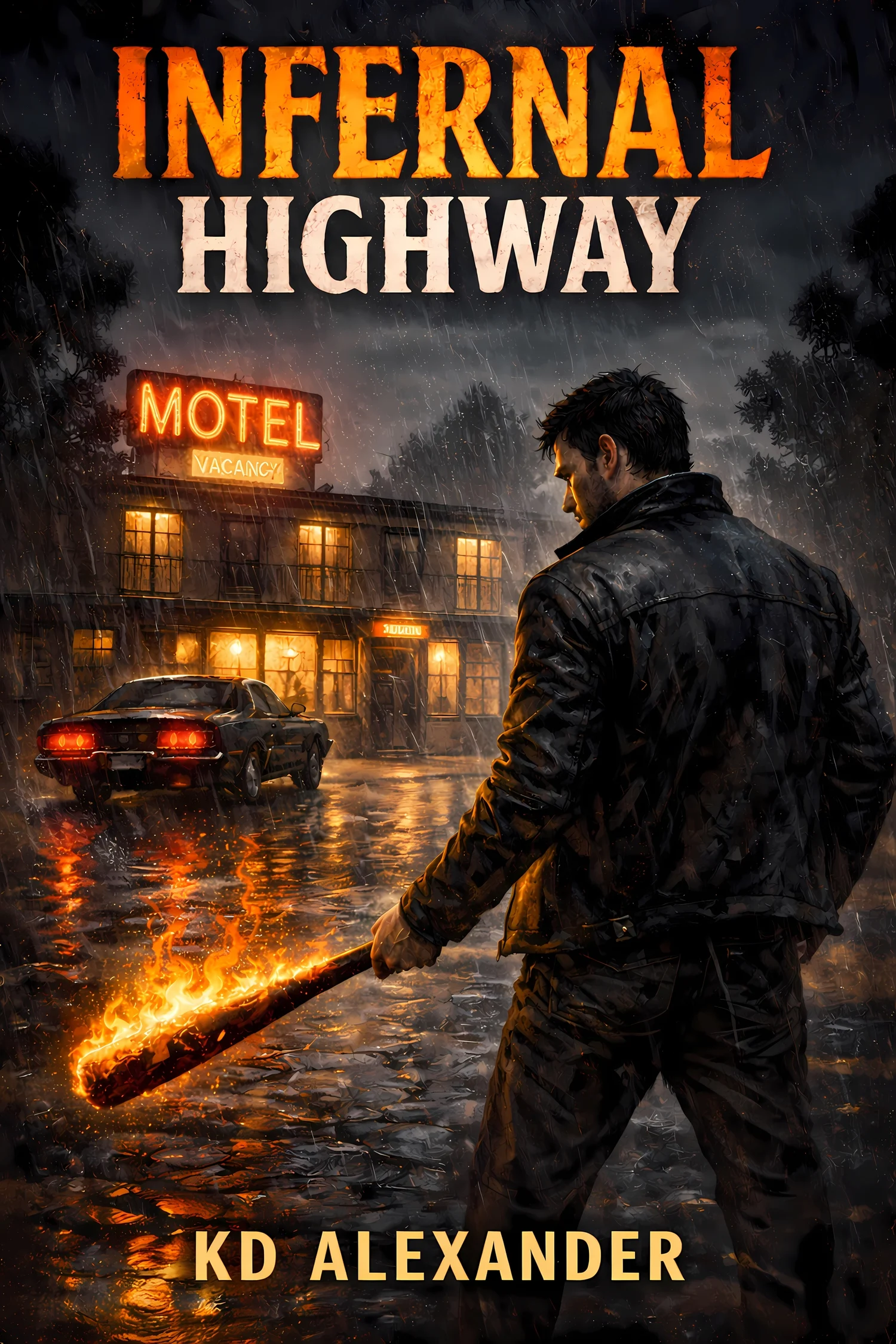
Urban Fantasy / Reality Breach Thriller
Ashboro called it a gas leak.
by kd Alexander
reader promise
Ashboro called it a gas leak.
cover copy
Ashboro called it a gas leak.
Blake Garrett knows what really came through — and it left something behind.
The body behind Booker’s Pawn was placed, not dumped. Chest cracked open. Not a drop of blood on the concrete, and a binding mark carved low on the brick wall where nobody was supposed to look. Where the man’s heart should have been, somebody had wedged a relic.
Blake walks it out of evidence in a sealed bag and doesn’t make it thirty miles before the thing starts hammering the inside of his trunk.
It kills his electronics. It reroutes his GPS to a road that isn’t on any map. And by the time he holes up in a roadside motel with the neon half dead and the rain coming sideways, he understands the worst part: the relic isn’t cargo. It’s bonded. It runs on his pain — every scar, every bad night, every name he couldn’t save — and there’s no handing it off to anyone.
Littlefoot’s people are running sniffers on every block, and Blake’s marker is the only reason the city is still being polite to him. Lord Wilfrey has stopped asking nicely and started sending Umbra kill teams through the front door. And a cult is seeding tragedy across Ashboro — murder by murder, overdose by overdose, anniversary by anniversary — tuning the walls of the world thin enough to punch through.
His only ally is Monica Rambo, a warlord in a cocktail dress who’s tried to kill him before and will absolutely do it again once this is over.
Wolves on remote leashes. A chapel on a dead stretch of highway. A breach opening from the inside.
No badge. No backup. No parades.
Infernal Highway is Book Two of The Umbra Venatori — hardboiled urban fantasy with a mouth on it, for readers who like their wizards broke, their monsters mean, and their heroes patched up with duct tape and cheap whiskey. One-click and get back on the road with Blake Garrett.
sample chapters
Formatted for comfortable reading on desktop and mobile.
They’re never gonna report what really happened, you know.
Let’s start with the fact that my apartment smells like day-old burnt coffee, stale Chinese, and raw nerves. The TV’s doing its best to crank up the misery, every flicker throwing blue light across the walls like a distress signal from somewhere you don’t want to be. Arianna’s hunched over on my thrift store couch, strangling a pillow to death and letting the news anchors ladle pureed horse shit straight into her frontal lobe.
“Authorities are treating the incident as unrelated gang violence and urge citizens to avoid the affected blocks while repairs to the gas line continue—“
Yeah, sure. Gas leak. Must’ve missed the part where stray fumes rip people in half and leave lungs plastered to the ceiling like party decorations. I bite back a snort, mostly because Arianna looks ready to break in half herself. Dark bags under her eyes, jaw clenched so tight I’m betting she could crush gravel in her teeth. She hasn’t slept. Maybe she doesn’t want to.
I’m parked a few feet behind her, trapped in the world’s dumbest staring contest with the TV. Part of me wants to put my fist through the screen. The rest of me wants to let her keep watching, so she can see for herself that the city doesn’t give a shit about anyone’s truth—least of all hers. I don’t even realize my fists are balled until my nails start carving little half-moons into my palms. The skin’s already got ridges from last week. Funny thing about scars—they don’t fade when the nightmares keep rewriting them.
I almost say something. Almost. Instead, I let the silence stretch. The anchors keep chatting. The city’s official line is that nothing matters, nobody cares, and traumas are best swept under the rug until the bulge trips you on your way to the liquor store.
Arianna used to be the one who’d call out every lie, every half-assed excuse, whether it was the mayor or a drunk neighbor two floors up. Now she’s swallowing the story whole, not even stopping to chew. I wanted to say something useful. I didn’t have anything useful.
Finally, I can’t take it. The words come out hard—harder than I want.
“They’re never gonna report what really happened, you know.”
Snap. The sound cuts through the room like a shot. Arianna flinches; her grip tightens on the pillow until her knuckles could pass for chalk.
She doesn’t answer. Doesn’t even look at me. The TV keeps ranting about “tragic accidents” and “unexpected violence.” I drag in a shaky breath. Nice job, Garrett. Real comforting.
Whatever. I slide around the coffee table, drop onto the couch next to her, and—after a three-second debate with self-loathing—risk resting my hand on her arm. She goes stiff, muscles locked and loaded, but then she lets herself sink against me. Just a little. Just enough. Her hair smells like that shampoo she buys at some organic place downtown, bright citrus and something green underneath. I focus on that, and not the way her whole body’s trembling.
We don’t talk. All I can think is the slaughterhouse was just the opening act. The city’s not done. The monsters sure as shit aren’t, either. Somewhere out there, another fuse is burning, and we’re both sitting here like it’s not about to blow us to hell.
I open my mouth, about to say something—anything. Before I can, my phone rattles across the coffee table, lights up, and vibrates like a coke-addict in a thunderstorm.
Ethan Ash.
Goddamn it. He’s still a badge. Department made it clear they’d rather eat glass than see me again, unless it’s through the sights of a Taser. I stare at the screen too long, wrestling with the urge to let it go to voicemail. I don’t. Because I’m a goddamn idiot.
I thumb the answer and grit my teeth. “Garrett.”
Static. A couple seconds of heavy breathing. Then Ash’s voice, stretched thin enough to snap. “It’s Ash. Sorry. I, uh… I know I’m not supposed to reach out but—shit, Murphy said to leave this alone, but—“
I cut him off. “Murphy’s usually right. You want to tell me why I’m not enjoying the soothing sounds of late-night infomercials instead of this?”
He swallows. Loud enough to hear. “There’s a body. Behind the pawn shop on Second. It’s… man, it’s like the slaughterhouse. Ripped. Carved. The ME found something jammed inside the chest cavity where the heart’s supposed to be. Like a relic, or—I don’t know what it is, Blake. Nothing in the database. And someone put a sigil on the concrete outside. Big. Wrong-looking. I don’t know where else to go with this.”
I moved to the window. Old habit—scope the street, make sure the conversation’s private even when the apartment’s on the fourth floor. Ashboro blinked back. Wet neon, busted gutters, people sensible enough not to know what I knew.
“No blood on the ground?” I said.
A beat. “How did you—no. Clean. Like the body got dropped there.”
“Don’t touch the relic. Don’t let anyone else touch it either. Send me photos of the sigil and the address.”
“You’re coming?”
There’s no mention of psych evals. No digging at my supposed “PTSD.” Just that edge in his voice—the kind of fear you can’t medicate away. “Yeah,” I said. “I’m coming.”
Arianna’s watching me now. She’s turned, just a bit, enough to catch the look in my eyes. She knows what this is.
I squeezed her arm once, then shifted the phone to my pocket.
“You have to go, don’t you.”
Not a question. I nodded. “He needs me.”
She exhaled, slow. Didn’t argue. Didn’t guilt-trip. Just the hush of a world where nothing goes right.
“I’m sorry,” I said.
She shook her head, hair falling over her eyes. “Just—don’t end up on the news. Not for the wrong reasons.”
Joke’s on her. I’m never on the news. City doesn’t report what really happens.
“I’ll try to keep the crazy to a minimum,” I said.
She snorted. Almost a laugh, but sadder than anything I’d heard in weeks.
My leather jacket was on the hook by the door. Cold at the collar when I shrugged into it, soft at the elbows, and there was a brown stain on the inside of the right sleeve that hadn’t come out in three washes. I didn’t look at it. I checked the gun out of reflex—the weight settling into muscle memory the way bad lessons always do. Then my staff, leaning against the wall next to the door where it always was, the Dagaz rune worn smooth from use. I picked it up, felt the familiar heat of it in my palm, and leaned it back against the wall.
Not tonight. Not for a crime scene with uniforms watching.
Ash’s text hit while I was pulling on my boots. Address, two photos, a third I could only glance at before I had to put the phone face-down on the counter for a second.
The smell hit me even through the photo. I know that sounds insane. But there’s a thing that happens when you’ve been doing this long enough—your aura starts reading images the same way it reads rooms, picking up resonance that photographs probably aren’t supposed to carry. This one carried plenty. Cold stone and burnt copper and something underneath that I didn’t have a word for, the olfactory equivalent of a word in a language you’ve never studied but somehow recognize.
I picked the phone back up. Made myself look.
The relic in Ash’s photo wasn’t jewelry and it wasn’t random. It was a construct—deliberate, old, designed with something specific in mind, the way a key is designed for a specific lock. My back teeth ached just looking at it. Whatever it was, it was active. Whatever it was, it had already been used tonight, and it wasn’t done.
I pocketed the phone and moved to the door.
I glanced back one last time. Arianna hadn’t moved. She was swallowed up by the couch, arms tight around that pillow, eyes fixed on the TV’s storm of light and lies.
She didn’t look up. Not even to say goodbye.
The city at 1 a.m. has a specific personality. Quieter than it pretends to be during the day, louder in the ways that matter. The rain had thinned to a mist that streetlights turned into halos. I drove through three green lights without trying, which never happens in Ashboro, and took it as the universe’s way of apologizing for what came before. Or maybe as a warning that it needed me somewhere fast.
The relic’s resonance hadn’t stopped. Even locked in a sealed bag in a trunk I wasn’t touching, I could feel the edge of it—the way you feel a headache starting before it arrives. My aura kept trying to reach for it and I kept pulling back. That was going to get old fast.
I ran through what I knew, which wasn’t much. Body placed deliberately. Blood absorbed by the ground. Sigil marking the location. Relic designed to function as a component, not a standalone object. A component in what, and pointed where, I didn’t know yet. But I’d seen enough of this flavor of wrong to recognize the shape of it, even when I couldn’t name the thing inside the shape.
Something was building. This was a piece of it.
Booker’s Pawn on Second was the kind of place that looked closed even when it was open, and looked guilty even when it wasn’t. The sign hadn’t been lit in years; I knew because Murphy had a running bet with himself about when Booker would finally take it down. So far, Booker was winning.
Crime scene tape. Two uniforms I didn’t recognize. A forensics van with its back doors hanging open. I flashed the old badge out of reflex—not technically mine anymore, but nobody’d asked for it back and I hadn’t offered—and the uniform waved me through without looking too hard. That was Ashboro. Everyone was tired.
The alley behind the shop smelled like dumpster, cold rain, and something chemical underneath—sharp and wrong in a way that made my sinuses sting and my aura go flat and quiet. That chemical note didn’t belong to the ordinary world. It belonged to what I’d been trying to stop thinking about since I looked at that photo.
The body was covered, but the markers told the story. Seated position, back against the dumpster, legs out straight. Arranged. Nobody falls like that from an attack. Someone had time and confidence enough to be deliberate, and that was its own kind of terrifying. I’d worked homicides long enough to read the difference between a body left and a body placed. This was placed. This was a statement.
A tech in a white suit looked up from where she was crouched near the marker ring. “This is a closed scene.”
“Consulting,” I said, and held up the badge. She squinted at it, decided it was someone else’s problem, and went back to her work. That’s Ashboro for you.
Ash materialized at my shoulder. Up close he looked worse than he’d sounded—gray under the eyes, jaw working like he was chewing on something he couldn’t swallow.
“Relic’s with the ME,” he said, low. “I made them bag it separate.”
Smart. “Good. Don’t let it touch anything else.”
I crouched at the edge of the marker ring. The concrete was dry except for one dark seam running from where the chest had been—about an inch wide, running straight to the wall like a drain channel, like the ground had opened and swallowed the blood. I’d seen that before, once, in a basement under a warehouse that the city’s official report described as a “gas explosion.” I pressed two fingers to the edge of the seam. Cold, even through the gloves. Wrong-cold. The kind of cold that radiates up rather than down.
“How long has the body been here?” I asked.
“ME says six hours, give or take. Scene was called in around ten.”
Six hours and the concrete still felt like a freezer door. That wasn’t the body doing that. That was whatever had fed here.
I stood and moved to the back wall. Just above the base of the brick, barely visible in the crime scene lighting, was a pattern gouged into the mortar and traced over with something dark and matte. Not paint, not blood—though it wanted you to think so. I got closer than was probably smart. It smelled like ash and copper and cold stone and the particular ozone tang that my aura uses to tell me I’m standing somewhere I absolutely shouldn’t.
A binding mark. An anchor point. Designed not to trap something in, but to mark a location as used—the way you’d mark a coordinate on a map.
Part of a sequence, then. One mark among others, somewhere in the city, all of them pointing at something I couldn’t see yet.
I took a photo. Straightened up. Rolled my neck until something cracked.
“Ash. This goes nowhere. Standard paperwork on the body, relic goes into evidence pending analysis, nobody talks about the sigil. If anyone asks why the mark isn’t in the report, you didn’t see it.”
“And if someone notices it in the photos?”
“You were looking at the body. Easy to miss something low on the wall.” He didn’t look convinced. “Ash. Someone put that mark there because this location matters to them. If it makes it into official channels, they know we found it. Right now the only advantage we have is that they don’t know we know.”
He chewed on that. Nodded slowly. “And you?”
“I’m going to find out who left it here.” I looked at the dark seam in the concrete one more time. “And I need the relic.”
He blinked. “That’s evidence.”
“Call it a consulting fee.”
He looked at me with the face of a man who knows he’s making a bad decision and is doing it anyway. I recognized the expression. I see it in the mirror a lot these days.
Twenty minutes later I was standing at my car with a sealed evidence bag in my hand, the weight of it slightly wrong—heavier than it should be, or lighter, depending on which second you were holding it. The relic shifted between the two states in a way that made the skin of my palm itch through the plastic. Ash watched from the alley mouth.
“You know what you’re doing?” he called.
“Not remotely,” I said.
I put the bag in the trunk. Got in the car. The relic hummed through the plastic and the metal and the upholstery and settled somewhere behind my back teeth—patient and specific, like it had been waiting for exactly this moment, and had all the time in the world to finish whatever it had started.
I drove.
I never learned to drive stick, but I could make a twenty-year-old American sedan coast down a blacked-out highway with a trunk full of demon shit and nothing but bad decisions riding shotgun. That’s a skill you don’t list on a résumé, but maybe you should.
Nothing on the road but me, the rain, and the city of Ashboro bleeding out behind me in the rearview. Headlights stretched out on the asphalt, two piss-yellow tunnels fading into nothing. I’d set the radio to “anything but country,” and it still found Merle Haggard. I left it. Might as well.
The artifact in my trunk wasn’t so easygoing.
First sign was the rattle. Not so much a gentle knock as a pissed-off poltergeist crammed into a steel dog crate, desperate for a smoke break. Every pothole, every groove in the road, set it thrashing against the wheel well with a rhythm you couldn’t ignore. A tattoo of “fuck you” in Morse code.
Second, the hum. High-pitched, like the dentist’s drill they reserve for insurance fraud cases. It started gentle, then cranked up by degrees, crawling over my nerves until I wanted to reach for a pair of pliers and rip out my own goddamned molars. By the time I hit county line, my ears vibrated, and my tongue felt like I’d licked a roll of pennies for a bet.
Which, by the way, I have. Story for another time.
Third was the taste. Copper and battery acid, coating my teeth and the back of my throat. I coughed, spat into the empty travel mug rolling around the floorboards, and muttered a curse at the thing in the trunk.
“You start bleeding through the panels, I’m setting you on fire,” I promised.
Out loud. Because I’m alone, and that’s how it works now.
Nobody to contradict me but Merle, and he already knew when to keep his mouth shut.
Of course, the phone rang. Murphy, not Ash — Murphy was different. Ash called when something looked weird. Murphy called when the weird thing was about to get expensive.
I thumbed it open while steering with my knee, which tells you everything you need to know about my survival instinct these days.
“Garrett,” I grunted.
“You took it.” Flat. Not a question.
“Good evening to you too.”
“Blake.” The way he said the name — a man standing at the edge of something and deciding whether to step back. “Littlefoot’s people were already asking about that address before the scene tape was up. Heard it from two sources inside three hours. They want to know what got signed out of evidence.”
I kept my eyes on the road. “What kind of asking?”
“The quiet kind. Which is worse.” A pause, and I could hear him deciding how much to say. “Whatever you’ve got in that car right now — if Littlefoot wants it, you need him thinking it’s still bagged on a shelf somewhere.”
“He doesn’t have that information from me.”
“He doesn’t need it from you. He’s got people who watch who walks out of alleys.” Another pause. “Just watch yourself on this one. More than usual.”
He hung up before I could ask what more than usual looked like, which was its own kind of answer.
The car lurched as the artifact jumped, slamming against the trunk lid hard enough to make the metal groan. Right on cue.
As soon as I tossed the phone back, the radio went full static—loud, hostile, like a blender full of gravel and angry bees. The dash clock flickered, numbers crawling backward. GPS screen went midnight and never came back. I was driving by muscle memory and the dull echo of the artifact throbbing through the car frame.
Somewhere in there, the rain started. Not gentle, not even a warning. One second, dry pavement; the next, an airborne dump truck unloading on the windshield. Wipers fought a losing battle, blades squealing as they tried to keep pace. Visibility dropped to “choose your last words wisely” and kept sinking.
I rolled the windows, cracked the glass for air, and tried not to gag on the taste of old pennies.
Every so often, the lightning would pop so close it painted the interior of the car white and left afterimages dancing on my retinas. Thunder followed, low and long — a monster’s lungs, sucking oxygen out of the sky.
I laughed. Sounded crazy, but what the hell. You learn to find humor wherever the universe leaves it.
“You ever regret not being an accountant?” I asked the artifact.
It rattled back at me, like it understood.
Two minutes later, the rain managed to kill what was left of my dignity. The wipers gave up; the headlights flickered. I pounded the dashboard with the heel of my hand, swore at everything that built Chevrolet, and wondered if this piece of junk could double as a flotation device if things got really rowdy.
The phone lit up on the seat. Not a call — three texts, arriving in pieces the way messages do when the signal keeps dropping.
Arianna.
You left your coffee mug. And your phone charger.
Then I know you can’t tell me where you’re going.
Then, after a gap long enough that I thought the connection had died, Come back whole.
I read them twice at a red light on a nowhere county road — no cross traffic, no reason for the light to exist except spite. She hadn’t asked me to call. That was Arianna being careful with me, which was something I didn’t deserve and didn’t know how to receive. I sat through three light cycles and then I drove.
Ahead, the storm looked meaner. Lightning stitched the sky with jagged blue lines, each flash spotlighting the sign for the next exit. The highway shimmered with standing water, every puddle a potential ticket to hydroplaning glory.
The artifact hummed louder. Tongue went numb. I reached for the bat in the passenger footwell—a comfort habit, sure, but also practical. If the artifact decided to break free, I’d rather be armed, even if my “wand” was Louisville Slugger and not a piece of mythical yew, thank you very much.
The car bucked. My aura flexed. Every time I got pissed, it got worse—machines hated me, which meant I was one bad day away from living in a tent down by the river.
Great. Living that dream.
A sudden gust slammed the car sideways. I fought the wheel, cursing out loud, watching the speedometer hiccup between numbers before the dial just fell limp, dead. For a half-second, all I heard was the hum in the trunk and my own blood pounding in my ears.
I talked to the storm instead. “You got anything left, asshole? Or you just gonna keep thumping my trunk and hoping I lose my nerve?”
I braced my left hand flat on the door to steady the shaking, right hand clamped on the steering wheel so hard my knuckles went ghost white. My knees ached. Old scars from older cases complaining about the weather.
“Almost there,” I muttered.
Artifact thumped. Hard.
The rearview mirror caught a faint blue glow — reflected lightning, or something worse. I didn’t check.
Somewhere over the next hill, the horizon split open with a fresh lightning strike—bolt hit so close it lit up the whole world, throwing the trees into jagged relief. The thunder rolled in three seconds later, meaner than before, a bass drop that rattled the fillings in my teeth.
The artifact’s hum jumped up a notch. My tongue tasted like blood now.
I wanted to stop. I wanted to gun it and get this over with. I wanted, just for a moment, to go back to a time when “retirement” meant coffee and donuts and bitching about the city council.
Instead, I kept driving. Nothing else to do.
The electronics didn’t come back. The rain didn’t let up. But the artifact settled—almost smug.
I slammed my palm against the horn for no reason at all except to prove I was still in charge. The noise barely registered over the storm, but it was the principle of the thing.
“Fuck you,” I said to the dashboard, to the artifact, to the whole night.
Merle Haggard cut in for a half-bar of static, then died again.
I laughed and kept going.
By the time the city limits sign for “Welcome to Ashboro—Home of the Eagles” staggered past in the rearview, I’d lost count of the lightning strikes. Trunk rattled twice in the time it took for the billboard to vanish into the dark.
Then it stopped.
It just stopped. Mid-rattle, mid-hum, like someone had thrown a switch. The copper taste went with it. The high-frequency dental drill whine went with it. The car’s electronics came back on all at once — dash lights, clock, GPS — and the GPS immediately tried to reroute me toward a county road I’d never heard of, six miles east.
I let the silence sit for about four seconds and then I said, out loud, to nobody. “That’s worse.”
An artifact that rattled and hummed was an artifact doing something you could track. An artifact that went quiet was an artifact that had found what it was looking for and didn’t need to announce itself anymore. It had been noisy for a reason — disorientation, disruption, burning through my patience and my car’s wiring to keep me off-balance. Now it wasn’t doing any of that. Now it was just sitting back there in the dark, pointed at something I couldn’t see, patient in a way that nothing that old ever has to pretend to be.
I gripped the bat. Checked the GPS address — St. Agatha’s Road, no town listed, just a dot on the map in the middle of nothing. I didn’t take the reroute. But I noted the coordinates.
Rain thickened. The windshield blurred. I watched streetlights die as I drove under them, one at a time, which was new — they’d been dying in clusters before. Now it was singular. Sequential. Like something was counting.
For a heartbeat, the trunk shifted — not a rattle, a slow, deliberate slide, weight redistributing — and the silence from it took on a different quality. Patient. Pointed.
Ahead, lightning stitched the sky. Thunder gave chase. The city loomed in pieces, less like home and more like the set of a horror movie.
The rain hammered down so hard I half-expected the windshield to crack, maybe even cave in. Wipers screeched their last rites and smeared the water around like finger paints.
I punched the gas, but the headlights chased shadows only about twenty feet ahead. Past that lay gray soup, wet pavement, and the occasional ghost-reflector flickering in the mess. The world narrowed down to my lane, the silence from the trunk, and the specific dread of driving toward something that already knew you were coming.
I drummed my fingers on the wheel. Knuckles white. Rhythm desperate.
Thunder rolled overhead — deep, hungry, the kind that doesn’t give a shit how tired you are of it.
I didn’t slow down, because slowing down is for people with survival instincts. I just kept going.
Right on cue, lightning ripped open the sky. Bolt hit a tree barely two car lengths off the shoulder—seared the bark from top to roots, and for a split second the world was made out of light and terror. My hands jerked the wheel hard left. Car fishtailed, tires lost grip, hydroplaned. I didn’t even have to think. I just let the car glide, let out a “MotherFUCKER!” that echoed in the cab, and yanked it back to center before the trunk monster could use the moment to eat my ass.
It worked. Mostly. I took a chunk of side mirror off a road sign (Ashboro public works can sue me later), but I didn’t crash or spill the artifact. Score one for the home team.
The car’s lights flickered. Engine coughed. Within a mile the whole thing gave up — headlights died, wipers froze halfway, dash lights out. I coasted to the shoulder because stopping in the middle of the highway is a great way to get glassed by a semi, and this had not been my day for lucky breaks.
Engine ticked as it cooled. Rain hammered the roof. The trunk was still quiet.
I sucked in a breath and let it out slow. My aura liked to throw tantrums when I lost control, and tonight it had plenty of material to work with. Calm it down. Let the car rest. Or maybe it just explodes. Flip a coin.
It took a minute. Then — not thunder. A shuffling, scraping sound from the trunk.
I froze. Didn’t even blink.
It wasn’t my imagination—the artifact actually moved. Not a polite slide. It LUNGED, maybe an inch or two, and thudded against the back seat for emphasis.
I was that pissed. At an inanimate object. Nearly drew on it.
“This is already way more than a fucking favor,” I said to the rearview, which stared back at me like a black eye. “Should’ve sent a text. Would’ve been smarter.”
I put my hand on the bat, let the will flare for a second, and watched the sensation ripple out. My knuckles tingled, air thickened, and the artifact in the trunk stilled. Not in defeat—just waiting.
I tried the ignition. It whined, caught on the third go. Dash came on faint and flickering, wipers groaned back, headlights spat weak yellow light. Engine ran like a fever dream but it ran.
I didn’t look back at the trunk. Some things are best left the fuck alone. I checked the side mirror — still fucked — and sat for a moment with my hands on the wheel and the rain coming down and the specific smell of a car that had been fighting itself for thirty miles. Hot metal, burned plastic, and underneath both, faint as cigarette smoke in an old coat, something that wasn’t either. Old. Mineral. Wrong in a way that had nothing to do with the engine.
I rolled my shoulders and merged back onto the empty highway.
The storm waited ahead — black, brutal, and full of spite. Lightning stitched up the sky, thunder came after it. I merged back onto the empty highway and watched the GPS reroute itself again, unprompted, back to St. Agatha’s Road.
I hadn’t touched it.
I turned the screen face-down on the seat and kept driving. Behind me, in the trunk, the artifact stayed quiet.
That was the part I couldn’t stop thinking about.
The “P” in * SLEEPYTIME * had been dead for years. The rest of the sign threw cold blue neon across the gravel lot, but that one letter just flickered twice and quit. A gap in the word like a missing tooth. Rain hammered the corrugated overhang hard enough to make conversation impossible, and the lot was half gravel, half standing water.
Every motel room looked the same when you were running for your life. I could’ve been anywhere in America—pick a red-light district, throw a dart, bet you hit at least three Sleepytime Motels within stumbling distance of a liquor store or a bail bonds office. This one crouched like a condemned bunker on the edge of Route 14.
I didn’t roll into the lot so much as hydroplane. Gravel spat everywhere under my bald tires, a couple chunks even pinged the chassis as I swerved up to the front office. The sky above was losing its shit—fat bands of lightning chasing each other across the low clouds, thunder shaking the whole goddamn county. Rain pounded the windshield so hard the wipers basically tapped out, flopping back and forth in defeat.
If you’d told me a day ago I’d be the proud owner of a murder-mystery McGuffin, I’d have laughed until I coughed up a lung. Now it was humming like a tuning fork jammed in the cavity behind my left eye. Every jolt of energy from the trunk made the console lights pulse and the radio cycle through static, Beatles, and some late-night infomercial that sounded like it was being hosted by a demon on downers.
I killed the engine, just as a flash lit up the lot—bolt hit so close, it damn near lit the night like a movie set. For half a second, the car’s dash clock blinked “3:02” before blanking out completely. Solid. Even electronics were bailing out. I sat there, hands glued to the steering wheel, and listened to the storm argue with itself.
“Alright, Garrett. Showtime.”
I grabbed my jacket, made sure the .40 was in easy reach, and popped the trunk. The hum from the artifact instantly spiked. Made my fillings ache. I shot a glance back at the road—no headlights. No tail. Either nobody cared, or I was already old news.
The rain didn’t let up for shit. By the time I staggered around to the trunk, my hair and shirt were plastered to my skull. The air smelled like ozone and wet gravel—mixed with something sharp underneath, like copper wire stripped raw. I snatched the artifact up (wrapped in an old T-shirt I kept for emergencies—yeah, yeah, laugh it up) and then crammed the whole bundle under my arm, trapping it between my ribs and the sopping wet jacket. It quivered against my side, hot and restless, like a freakin’ heartbeat.
Tripping over puddles, I limped up to the lobby. The glass door banged open with less than zero fanfare. Inside, the Sleepytime’s concierge—or whatever the hell you called the guy running front desk for a shitbox like this—looked up, his face a moldy shade of yellow. Cigarette dangled from his lips, ashes curling right onto the counter. I pegged him for ex-con, or maybe just a guy who lost all his dreams one Keno ticket at a time.
“Room for one. Cash. No questions.” I dropped a wad of crumpled bills on whatever passed for a check-in mat.
He didn’t blink. “No pets. No fireworks. No screaming at midnight.” His accent was pure Ashboro, gravel ground through a meat grinder. He mashed the cigarette out, flicked a plastic keytag at me—Room 13.
Cute.
I snagged the key. Didn’t bother with change. The rain outside was getting biblical, hammering at the corrugated metal overhang like it was angry for being left out of the conversation.
The guy’s eyes lingered—on my limp, on the bundle under my arm. I shot him a smile that said “fuck off” in three different dialects.
He snorted. “Laundry’s at the end of the hall. You bleed on the sheets, you pay extra.”
“Not planning on redecorating. But I’ll keep it in mind.”
I shouldered the door back open and limped across the lot. Water sluiced down my collar and immediately soaked everything, jacket included. My pants stuck to my knees, the wound there throbbing in sympathy to the artifact’s pulse. The whole motel reeked of wet concrete and cigarettes, with maybe a hint of old piss for atmosphere. Classic.
I unlocked the room. Door stuck—warped frame—so I had to shove, hard, which sent a jolt of pain from my knee up to my spine. Inside, the light flickered on, desperate but already losing a battle with whatever was in the walls. Wallpaper peeled in complicated origami folds, old stains leaking through at the corners. Paisley, florals, something that may have started life as baby blue decades ago. The bed sagged in the middle, a long, greasy hollow right where your dignity would go if you’d ever had any. Carpet stank like a stale ashtray. Or maybe that was wishful thinking.
I slammed the door, double-locked it, and only then peeled my jacket off—artifact still cradled in the fold. It felt even hotter now, like carrying an angry animal wrapped in dead cotton. My fingers buzzed with static—the kind of sensation you get if you lick a battery, or stick your hand somewhere you really, really shouldn’t.
There was a cheap-ass dresser against the wall, fake wood veneer already curling off at the edges. The TV was one of those ancient CRTs, probably weighed more than I did. On the opposite wall, a digital clock blinked 12:00, the colon between the numbers pulsing like a hospital heart monitor.
I set the artifact—still bundled up, but already bleeding light through the fabric—on the dresser. It throbbed once, twice. The clock’s numbers spazzed, ripple of zeroes and slashes, then flatlined.
Perfect.
I slumped onto the bed. Springs immediately tried to eat my spine. The artifact hummed, louder in the silence, matching the storm’s rhythm outside.
“Fuck me running,” I muttered.
Because, truly, if there was anything worse than getting hunted by monsters, it was getting hunted by monsters while holed up in a motel room that smelled like every cigarette in Ashboro had come here to die.
Thunder cracked. The neon outside flickered, stuttered, then went completely dark—except for the P, which hung on stubbornly, alone in the blackness.
I stared at the artifact, still pulsing in the gloom, and tried to ignore the way my skin crawled every time the hum spiked. It wanted something. I didn’t want to know what.
I didn’t waste time. The instant my ass hit the saggy mattress, the artifact’s hum ramped up. Like it could sense my adrenaline tapping out Morse code in my veins. I didn’t know if you could actually get migraines from proximity to a supernatural relic, but if so, I was about to become a medical case study.
First order of business was not dying tonight.
I upended my pockets and worked fast. Salt packets from O’Malley’s—three of them—torn open and laid in a rough circle around the artifact before the grains could clump in the humidity. Pen clip bent into an S, set dead center. Bible wedged at the back, spine out. The artifact pulsed once while I was setting up, hard enough that my hands shook, and the pen clip shivered against the dresser surface. Something was responding. Whether that was good or bad, I hadn’t worked out yet.
The hum turned into a throb. Overhead, the lightbulb buzzed—then flickered, stuttering like a dying hornet. The TV, which I hadn’t touched, crackled to life. Static. Blue-white lines, cycling so fast they looked almost liquid. Sound blared. Teeth-grinding screech, like someone sandblasting a chalkboard.
I lunged for the TV and jabbed the power button. No dice. I yanked the cord from the wall. Still nothing—the screen just kept rolling through static and symbols that made my stomach twist. One of them looked an awful lot like the sigil Ash described at the crime scene.
“Cut it out!” I barked.
Static. Nothing else.
I dropped back, sweating. The rain outside ramped up another notch—it hammered the glass so hard, water started to seep through the unsealed corners of the window frame. Lightning kept scoring the sign outside, strobing me blind every three seconds.
The artifact pulsed again. My skin prickled from scalp to wrists, the way it does right before something swings at you. Bedside lamp popped, brittle plastic melting, the stink of scorched wiring filling the room.
This was worse than the car. The car's clock had died and that was it. Here, the TV was showing me sigils it shouldn't know, every piece of glass in the room was vibrating in its frame, and I could feel the resonance in my back teeth. My aura wasn't just leaking—it was broadcasting on every frequency at once. I grabbed the walking stick from the corner, just in case I needed to channel something or beat the next interdimensional creep to death with blunt force.
Phone. I needed to try Arianna.
I snatched my cell, thumbed her number with sweaty fingers.
It rang once, twice.
The artifact’s hum escalated.
Three rings, and the screen glitched—lines flickering, colors inverted—and then the whole thing went black. That was bad enough. Then the glass cracked, neat diagonal fracture straight through the display. The taste of copper hit the back of my mouth, sharp and metallic, undercut with the reek of old incense and burned plastic. I gagged, pressing my fist to my lips.
Something in the air shifted. The pressure in the room doubled, like I’d been stapled to the floor. Sweat rolled down my face, and the artifact looked to be breathing—all those little cracks in the stone flexing, rhythmically, like a lung full of poison.
I staggered to the window, drew the curtains, and glared outside. Rain so thick you could drown standing still. Lightning again. The neon sign out front pulsed three sharp times—bang-bang-bang—then faded, leaving the parking lot painted in shadow and afterimages.
Just fucking perfect.
I turned back to the artifact, barely breathing. I’d seen objects like this before. Not just dangerous—pointed. Aimed at something specific, the way a key is cut to open one particular lock and nothing else.
This thing on my dresser wasn’t a relic.
It was a bomb.
I circled the room, muttering swear words and more than a few prayers. My makeshift salt circle had started to dissolve, but the pen clip vibrated, twitching every time the artifact flashed. The air tasted like blood, and every time I blinked, I saw sigils—hung there, burned into the wallpaper, even as the pattern itself peeled away.
I eyed the artifact, mouth dry.
“Just a fucking paperweight, right?” I said.
Didn’t believe it for a second.
The artifact sat there, smug and unbothered. If anything, it pulsed harder, blue-gold filling the room, shadows stretching and writhing. Whatever was in that artifact was broadcasting. I could feel it—the way you feel a siren two blocks away before you can actually hear it. Something was going to pick up the signal.
I paced, counting steps. Five to the window. Three to the door. Eight to the cracked bathroom. I tried to steady my breathing, but the taste of pennies and magic hung thick. My aura was a dumpster fire, and every time I focused, the pressure only got worse.
Thunder shook the whole building this time. I heard plaster crack somewhere upstairs. My money was on the roof caving in before dawn. Maybe I’d get lucky—die in the collapse before whatever was hunting this thing showed up to finish the job.
I stared down the artifact, refusing to blink. It pulsed, relentless.
And outside, the storm just kept getting stronger. No power, no phone, no help coming. Just me and a bomb with a grudge.
Then the last flicker of light in the room went out, and I was alone with it in the dark.
The dark here was different. Not just no-light dark—thick, like it was pushing back. The storm strobed through the curtain edges every few seconds, but the flashes were too fast and too bright, burning afterimages into my eyes rather than giving me anything useful to see by.
I counted to three and reached for where my phone had been.
The cracked screen lit up for half a second. Then died.
Right. Okay.
I tried to reconstruct the room by memory. Dresser, three feet to my left. Artifact on the dresser. Salt circle, compromised—grains clumped and spread, probably past useful. Walking stick, leaning against the wall near the bathroom door. Eight steps, roughly. My left knee had opinions about eight steps in the dark, none of them polite. I went anyway.
The artifact was still humming. That was the thing I couldn't stop sitting with. Whatever had killed the lights, it hadn't killed that. If anything, the sound was cleaner now, stripped of interference—like the electricity had been competing with it and the electricity had lost, and now there was nothing between me and whatever the artifact was actually saying.
I moved toward the stick by feel, palms out. Found the dresser edge first—artifact heat came off it like an open oven, inches before my fingers made contact. I redirected, tracked the wall with my knuckles, and got my hand around the walking stick.
The Dagaz rune carved into the shaft warmed immediately under my palm. Not a lot. Just enough to know it was paying attention.
I pointed the stick at the artifact and felt stupid doing it.
“Alright,” I said, to no one. “Let's try this the dumb way.”
Channeling with the stick required focus, which required not thinking about the fact that I was standing in a pitch-dark motel room in front of a potential supernatural weapon while an actual storm tried to dismantle the building around me. I pulled at the aura—felt it respond, sluggish and overstretched—and pushed the intent down through the rune. Ward. Contain. Hold.
The salt circle lit up. Barely. A pale blue outline in the dark, like looking at phosphorescence through muddy water. The artifact pulsed against it, hard, and the ward flared bright for one full second before dropping back to almost nothing.
But it held.
I took a breath. Let it out slow. My ribs ached from where the artifact had been pressed against them all night, and the taste of copper was so thick I'd stopped noticing it the same way you stop noticing a bad smell after an hour. Outside, lightning hit something close—I heard the crack before the flash, which meant very close—and the building shuddered.
The artifact pulsed again.
The ward held again.
I kept the stick trained on the circle, back against the dresser, and did the only thing I had left to do.
I waited for morning.
A knock. The kind that said, “If you don’t open this goddamn door, I’m going to open your ribcage.” Every hair on my arms stood up and I felt the artifact pulse through the walls, like it was screaming at me to hide but also maybe eat whoever was on the other side.
I had my walking stick—let’s just call it my staff, since at three in the morning the only people awake are wizards and methheads—and I gripped it so tight I could feel the wood straining to splinter. My aura went haywire. The lights already hated me, but now they whined and flickered like angry spirits were trying to ghost-crowd the motel. My nerves screamed “trap.” My feet shuffled to the door anyway. Because I’m a fucking genius like that.
I didn’t call out. No “Who is it?” No “State your business.” I just pressed my shoulder against the warped wood, staff up, gun ready in my waistband, heart ricocheting around my ribcage. The knock came again—three sharp raps, not even pretending to be civil.
The door handle was cold. My palm left a sweaty print behind as I twisted it.
Creak. The air outside crashed over me. Rain hammered the far end of the hallway, drowning out the world, but right in front of me—there she fucking was.
Monica Rambo.
She looked like hell frozen over, then slow-roasted in a rainstorm. Her hair plastered to that sharp face, mascara dammed up under her eyes, evening gown clinging to her like it had given up any pretense of formality three miles back. High heels in one hand, a battered manila folder in the other, and a gaze that could cut glass.
I didn’t say anything. My body did. Shoulders braced, muscles tight. The staff came up instinctively. If her fingers twitched, I was ready to light her up, or at least try. Old reflex. Monica Rambo on your doorstep means a fight—or a last meal.
She didn’t blink. The only sign she wasn’t a marble statue was the way her chest heaved, breathing shallow, every muscle held tight. She wasn’t panicking. That was the thing about predators — they didn’t panic. They planned. And her eyes were already somewhere else.
The hallway stank worse than the room. Wet wool, cigarettes, and maybe a hint of ammonia, which could’ve been the carpet or just the Sleepytime’s signature scent. Her heels squished on the runner as she shifted her weight.
Thunder hit. The entire building rattled, ceiling tiles quivering, the light above us flickering like it had one last look at what was happening in the room and decided it wanted no part of it.
“Oh, good,” I said. “Company.”
Monica’s lips peeled back in what might, on another planet, pass as a smile. Here, it was just a warning.
“I’ve had better welcomes,” she said. “But I guess it’s true what they say—blunt force trauma counts as flirting, in Ashboro.”
“You know, you catch more flies with honey. Or maybe with a gun. Either way, you want something.”
She didn’t answer at first. Instead, she held up the folder, rain-splotched and starting to delaminate at the corners.
“Let me in, Garrett. I’m not here to play games in the hallway. Your neighbors are the type to call 911 if things get… noisy.”
“Lucky for you, most of them are comatose or dead.”
I stepped back, but kept the staff between us. She brushed past, dripping on the carpet, tracking a trail of wet misery into my sanctuary. The overhead bulb buzzed in protest as she entered. Her eyes—sharp as icepicks—swept the room. The bed, the buzzing artifact on the dresser, the fried lamp, ozone still hanging in the air.
She propped herself against the wall, one heel still dangling from her fingers. The folder hit the bed with a wet slap.
“Nice place. You redecorate often?”
“Only when something bleeds on the walls. Most nights I keep it casual.”
We traded glares. Her dress had shredded along the hem. One eyelash hung on by a thread. Still, she looked like she could kill me five ways before the coffee pot finished brewing.
“I don’t suppose you brought an umbrella,” I said.
She finally smiled—more like a grimace, but still. “I’d melt if I did.”
Lightning lit the room, the artifact on the dresser flared in time, and for a split second we both stared at it. She didn’t move, but her gaze sharpened.
“You’re braver than you look,” Monica said. “Most sane people wouldn’t keep that thing in arm’s reach.”
I shrugged. “Came as a set with the bullet wound and the dead-end pension. So, what’s the sales pitch? You here to try and take it from me, or just offering to burn the place down?”
She ignored that.
“I’m not here for your trunk’s prize.” She shoved the folder my way. “I’m here to stop it reaching people who’ll butcher cities with it. We don’t have time for a pissing contest.”
I stared at the folder. It had bled ink from one rainstorm too many. Top page showed three crime scene photos, at least one more horrifying than the last. The same symbol, carved in flesh, ringed in arterial red. You could almost smell the copper and bleach.
Underneath, a blurry scan of the artifact itself, surrounded by Latin runes. My stomach turned.
“Who’s keeping dossiers on me these days? I didn’t even get a mugshot for the first three murders.”
Monica’s tone lost its flavor. She spoke low, eyes locked on the artifact.
“You’re not the only one getting body drops. Two nights ago, Manhattan. Before that, Berlin. Same pattern. Same signature. They’re not random, Garrett. They’re calculated. Each time, the artifact levels up—drains the victim, leaves a calling card. Whoever’s behind this, they’re not screwing around.”
The artifact responded. Its hum spiked, blue-gold leaking through the fabric like a radioactive birth announcement. Every muscle in my back tensed. The TV—still unplugged, still dead—crackled once, and went silent. I didn’t like this. Not even a little.
“Manhattan and Berlin.” I let the words sit. “Same timeline as Ashboro?”
“Tighter.” She pulled her wet hair back from her face and held it there, thinking. “The intervals between events are compressing. Whoever’s running this ritual, they’re not on a timetable anymore. They’re in a race.”
I chewed on that. A distributed ritual, three cities, tightening intervals. My brain wanted to file it under Problems For Later. The rest of me knew there was no Later.
“You came alone?” I kept my face neutral, but old habits die hard.
She snorted. “You think I’d drag two rookies here? I want to solve the problem, not mop up their remains.”
I forced a laugh. “So noble.”
We just glared at each other. Cold air from the hallway drifted in, coiling around the artifact’s heat. The clock on the dresser spat out a string of zeroes and flatlined. The pressure behind my eyes spiked hard. Whatever the artifact was broadcasting, something out there was already listening.
Monica crossed her arms, hugging herself. The move was defensive, but she’d never admit it.
“Look, I don’t care what you think. I need you to understand—someone out there’s tying these killings together. They want the artifact, but they’re not in it for the fence value or bragging rights. They’re looking for destruction. Citywide. Maybe worse.”
The hum spiked when she said “citywide.” Hard enough that I felt it in my back teeth. I don’t know if Monica noticed. She kept talking. I made a mental note anyway — the artifact had opinions about that word, and I’d learned the hard way that relics with opinions were worth paying attention to.
I flipped through the photos. Jesus. They made the slaughterhouse look quaint. One corpse had been hollowed out, ribs splayed open like hungry fingers. A glassy orb had been jammed under the sternum, pulsing in the camera flash.
I stopped on that one.
Looked at the artifact on the dresser. Back at the photo. The orb in the dead man’s chest was the same color as the light bleeding through my T-shirt. Not similar. The same.
“This victim.” I kept my voice flat. “Did they make contact with one of these things before they died?”
Monica’s expression didn’t change. “Yes.”
My stomach dropped about six floors. “How long between first contact and—“ I gestured at the hollowed-out chest.
“Seventy-two hours.” She let that land. “Give or take.”
Seventy-two hours. I’d had the artifact since last night. My brain did the math before I could stop it — fast and clear and leaving absolutely zero room for wishful thinking about what that meant.
I tossed the folder back.
“And you think they’ll come here? To Sleepytime fucking Motel?”
She stepped closer, voice dropping to a hiss.
“They’re not far behind, Garrett. They’re not even pretending to hide it. They know you have the artifact—and now, so does everyone within fifty miles with a taste for Venicium blood.”
Outside, wind slammed the window. The hum ramped up. The light above us buzzed and died, plunging the room into murky gray, lit only by the waves of glow leaking from my murder souvenir.
Monica didn’t flinch. She leaned in, hands braced on the mattress, face inches from mine.
“We used to think you were crazy,” she said, voice hard. “Now I think you’re just unlucky. But that doesn’t mean you get to fuck this up for the rest of us.”
I stiffened, let the staff rest across my lap. If she made a grab, I could probably brain her with it, just on reflex.
“You got a plan, Monica? Or is this a guilt trip with extra paperwork?”
She didn’t answer immediately. Instead, she dug into her purse and yanked out another sheaf, this one slicked with rain and stained at the edges. She flattened it out, palm hard on the photo.
“Demonic signature,” she said. “That symbol you keep seeing? It’s a beacon. Every mage, every monster with enough sense to spell their own name, is going to home in on it. It’s already started. You felt it, didn’t you?”
I glanced at the artifact. The hum was damn near a siren now, drawing power from every dead bulb in a five-mile radius.
“No shit,” I said.
She pressed her advantage. “This is not human magic, Garrett. It’s not even clean Venicium. The Didiciti flagged this as ‘pre-collapse burning.’ That means, last time someone lit one of these, it wiped out most of a city block. We never found the caster, just a pit in the ground where the people used to be.”
Something hit the window — not rain, something heavier. A branch, probably, or the storm making a point. Neither of us looked. You don’t look away from someone in the middle of a threat briefing. It’s rude, and also they might kill you.
She shoved the photo closer, until the bloodstains smeared the plastic under her nails. “Does that look like something you want spreading across Ashboro?”
No. It did not.
I thought about Arianna on the couch back home, watching the news because it was the closest she could get to the work I wouldn't let her near. I thought about Murphy pulling doubles because they were always short on bodies and he never once complained. I thought about Ash's face under the crime scene lights, and the smell of that back room, and the way the relic had felt in my hand before I'd understood what it was.
I felt my fingers twitch on the staff.
She watched, waiting for me to explode, or maybe just admit I was already outgunned.
Instead, I nodded, real slow.
“I get it. You want me to be your canary in the coal mine. Let me die first, so the Didiciti can swoop in for cleanup.”
Her expression flickered. Not sympathy—more like, “finally, you’re using the right side of your skull.”
“We do what we have to,” she said, and there was steel under that. “Sometimes that means trusting people you’d rather see dead.”
I couldn’t argue with that. Every cop, even the fired ones, knows sometimes you fight next to the asshole you hate most. You don’t have to like them. You just have to trust that they want to get out of the building as badly as you do. Sometimes that’s enough. Sometimes it’s all you’ve got.
The air between us got thinner. The artifact vibrated on the dresser, every second louder.
I let out a breath, counting the beats.
“So, what? We hole up and wait for them to come knocking?”
She shook her head. “They’ll burn this place down if they have to. No negotiation. No warning.”
I grunted. “Charming.”
Thunder hammered at the walls. The light above the dresser flickered back to life for half a second, then died again. Out in the hallway, I heard doors creak, footsteps—maybe just the building settling, maybe not.
I narrowed my eyes. “You sure you weren’t followed?”
She didn’t flinch. Just squared her shoulders and set both heels, ready for a fight. “I lost them three exits back. You think I’d show up dripping wet if I hadn’t run every light on the way here?”
“Fair point,” I muttered.
We stared at each other. Neither one of us blinking.
Finally, she broke.
“Garrett, listen. You’re good at putting monsters down. I’m good at cleaning up the mess. If we don’t work together, that thing ends up in hands that’ll reduce this city to an obituary. You want that on your record?”
I bared my teeth in a smile.
“My record is already shot to hell. But I’ll play ball. For now. Just keep the monologuing to a minimum, will you?”
She snorted, half-amused, half-exhausted.
“Deal.”
The artifact let out a shudder. The dresser rattled, and the salt circle I’d made earlier sizzled—literal smoke rising from the cracks. Whatever was coming, it wasn’t waiting on us.
Monica grabbed the folder and stuffed it back into her purse. She’d locked it down. Her knuckles were white, but the tremor in her hand was gone.
She jerked her chin at the artifact.
“Next move’s yours. You’re the one holding the bomb.”
I stepped past her, staff leading, and yanked the T-shirt free. The artifact’s light hit us both—blue and gold, burning away the darkness. Monica hissed and shielded her eyes. I barely managed to keep from gagging at the metallic tang that hit my tongue.
Stuff in the room started to twitch—curtains, lamp cord, the fucking bedspread. All alive, all angry.
Then the artifact’s hum dropped a register — lower, slower, almost like breathing.
I’d heard that from something before. Not a relic. Something that had just found what it was looking for and stopped needing to search.
“Move,” I said.
W e didn’t get far. The artifact decided it had its own agenda before we reached the door — the hum built fast, ratcheting from background noise to something that made the fillings in my back teeth sing in under three seconds.
The dresser vibrated hard enough to rattle the fake-wood panels; the glass on the nightstand skittered to the edge and almost took a header. Metallic taste smacked the back of my throat, copper and ozone and locker-room misery.
I braced with the staff, boots grinding through ancient carpet glue and whatever biohazards Sleepytime left for ambience. Monica’s eyes locked on the artifact, pupils blown wide, every inch of her vibrating with the urge to murder something, ideally not me.
Outside, the storm went absolutely nuts. Lightning lit up the parking lot like a strobe; thunder punched the walls so hard the bedframe humped across the floorboards. Rain hammered the window in horizontal sheets. The P from the Sleepytime sign was the only thing left glowing—like the universe wanted to remind me exactly how pathetic this setup was.
Monica moved first. She lunged for the nightstand, sweeping up what was left of my salt packets, the bent pen clip, even the stained room-service menu. She worked fast, snatching open the packets and slamming the powder down around the artifact in a double ring. The pen clip hovered, trembling in the blue-gold light. Monica muttered, “Fucking amateur hour,” and then spat three words
“ Orbis Ligare. Sal et ferrum. Praeventum! ”
The salt fizzed. The hum hit a new octave, somewhere between “jet engine” and “demonic chorus.” I grinned, even as my teeth vibrated out of my gums.
“That your professional opinion?” I shoved the walking stick into my palm, digging for what little power I could muster. It was like wrestling a bad hangover and a live wire at the same time. “Always admired your bedside manner.”
“Eat dirt, Garrett,” Monica hissed. She kept low, one hand steadying the salt ring, the other fishing the pen clip into a tight spiral on the artifact’s crown. Her lips peeled back from her teeth. She didn’t look at me—kept her focus on the bomb we’d adopted.
I shut up and got to work. The room warbled; the shadows in the corners thickened, pooled, crawled up the moldy wallpaper like tar. The bulb above us winked on and off, the filament stretching with each pulse.
I limped to the nearest wall, dragging my staff through the carpet. I channeled—raw will, nothing fancy, just pure stubbornness. My fingers went numb. I drew Dagaz—my old friend, the one gift Baldr ever gave me that didn’t fuck up my entire day.
Lines traced in the filth. The carpet smoke hung around my ankles. Behind me, Monica’s breathing got choppy; I heard her muttering more incantations, the cadence angry, every syllable fired like a bullet.
I circled the room, dragging the staff like a kid with a stick at the zoo, knowing eventually something was going to bite. At every corner I planted a new rune—one by the door, one by the window, one right over the swampy air conditioning unit burping mold into the world. It was a poor man’s perimeter, but it was better than nothing.
The artifact didn’t like it. Each time I braced the staff, drove the tip into the carpet, the hum jumped, forcing the table to judder closer to the wall. A filmy heat pulsed off the artifact in waves; the air itself warped, as if the molecules were getting hammered into new shapes. I caught a whiff of something that wasn’t quite sulfur, wasn’t quite gun oil, but would haunt my sinuses for the rest of the month.
“Jesus. This thing’s got a mean streak,” I said.
Monica risked a glance up, her face slick with sweat and something closer to panic. “You said you wanted a challenge, right? You’re not scared, are you?”
I flashed her a crooked smile. “I’m always scared. Keeps me young.” I stabbed the staff down again. The wood shuddered; somewhere deep in the grain, the Dagaz rune flashed white.
Monica’s eyes cut to me for a half-second. “You going to start quoting Wilfrey next? Tell me how the Umbra would do it better?”
“Containment’s not the worst idea in the room,” I said.
She leaned into the artifact, fingers sketching salt lines between the cracks. “I have a plan that doesn’t involve blowing up half the city. Unlike the last time you were left to your own devices. Remember Von Brennar?”
The name hung there, pulsing, and for a second the hum dipped—like the artifact wanted to listen in.
I gritted my teeth. “It wasn’t my fault.”
“Doesn’t matter,” she snapped, voice small but sharp. “It’s always someone else’s fault. We clean up the mess, and then the mess keeps coming. Rinse, repeat, die tired.”
I stared at my staff. “You think I wanted this job?”
She didn’t answer. Didn’t need to.
I finished the circuit, dragging fresh lines of will around the whole shitbox of a room, then limped back to the dresser. The artifact looked meaner than ever. Blue and gold light pulsed against the T-shirt, spitting shadows that twisted, flickered, clawed at the peeling wallpaper.
I glanced at Monica. Her jaw was set, the kind of stubborn only years of bad history could anchor. She’d finished the salt ring, now doubling it with torn strips from the room-service menu—paper soaked in something that immediately started to brown and curl against the light. This thing was running hotter than we even guessed.
Monica dug in her bag, fished out a lighter, and flicked a flame over the edge of the menu. The smoke wafted around the artifact, and she chanted under her breath. The blue light folded in on itself, licked at the paper, then snapped back as the fire caught.
Nothing about this looked right.
The window started to bow in, the glass buckling under the pressure of the storm. Lightning cracked so close the entire wall went white, and the rain tried to break in through every seam.
I held my staff out, aiming at the artifact, just in case it tried anything to escalate the party. “You know, I almost miss dealing with regular old corpses. At least those didn’t talk back.”
“Give it time,” Monica said, voice low. “Everything talks back. You just have to piss it off enough.”
The air in the room had thickened; time felt loose. The back of my skull prickled, something low and hot crawling along the edges of the circle I’d carved, and every runed corner buzzed in harmony with the artifact’s murderous pulse.
“You ever wonder why we do this?” I muttered.
Monica didn’t hesitate. “No. I know exactly why. I just wish everyone else would stop pretending it’s about justice, or safety, or whatever bullshit slogan makes them sleep at night.”
I barked a laugh. “You sleep?”
“Not really.” Her lips twitched at the corner. “You?”
“I gave that up after the second year on patrol. Only got worse since.”
She nodded like she understood, but turned her focus back to the circle. With the rings set, she traced a fingertip along the edge, murmuring something so quiet even the artifact hesitated to swallow the sound.
I checked the shadows—those corners kept wriggling, almost thinner, darker, like something tried to chew through the boundary I’d scraped into the walls.
“I don’t like that,” I said.
“You shouldn’t,” Monica grunted. “Means it’s working. Or at least, pissing them off.”
The hum leveled out, mean and brutal, and the metallic taste got so thick I nearly gagged. Sweat trickled down my back. My staff started to tremble—either from the artifact, or just my own nerves. But I held the damn thing steady.
Monica finished her pass, then straightened, hands on her hips. “You’re up, hero. If you’ve got any real mage tricks, now’s the time.”
“Last time I tried this, the desk clerk shat himself and every light in Ashboro died for an hour.”
She grinned, wolfish. “Keep your expectations low. Maybe we can just kill the lamps and not the motels for once.”
I squared up, walking stick held in both hands, and focused. The Dagaz rune burned; my own pulse thudded in my teeth. Voice tight, I let the will boil up, then spat the words.
“Aegis Brevis!”
The staff glowed, faint and ugly, sparks crawling across the knurled shaft and pooling in the carved rune at the grip.
A shimmer surged along the salt perimeter. The shadows bucked, recoiled from the light. The artifact snarled—no other word for it, the thing howled—and all the lights in the room flared one last time, then snapped to darkness.
Black. Silence, except for the hunt of the storm.
Monica and I just stood there. Her face glistened with sweat and spite, but she held her ground, never even flinched.
“Not bad,” she said, barely a whisper.
I grinned, teeth bared. “Eat your heart out, Wilfrey.”
She gave me a look that could kill a rat at fifty paces. “Mention that name again, and I’ll gut you before the artifact does.”
I started to lower the staff. Half a second of quiet — just the rain and our breathing and the candles doing their best.
Then the artifact decided it had other ideas.
The artifact didn’t want to play nice. It wanted a goddamn encore.
The hum, already worse than a root canal with a jackhammer, ratcheted higher. The dresser bucked, slamming itself against the wall—looked like it wanted to tunnel straight through to the next county. Every molecule in the room vibrated. My eardrums went tight. The blue-gold light stretched thin, and for a moment everything froze.
Above the artifact, space just… split.
I don’t mean a puff of smoke or a Harry Potter wand spark. This was a razor-thin seam, carved right through the air above the dresser. The border warped, light refracting around it like the world’s shittiest Instagram filter. The crack grew, just a hair, just enough for the human eye to hate itself. You could see the walls bend; you could taste fear.
Monica made a noise—half curse, half prayer.
A cold flooded the room that had nothing to do with the storm. The pressure went full predator—the kind of prickly dread you get right before a car crash, or maybe when you know there’s something under the bed and it’s got your number. I watched the sliver pulse, watched it breathe, and for a heartbeat, the shadows in the tear rippled like muscle.
Something on the other side sniffed. I don’t know how else to say it—the hair on my neck stood up and every nerve shrieked that we’d been spotted.
“Shit!” I bellowed.
I didn’t wait. I swung the staff overhead and slammed it down, hard, right at the base of the dresser. Pain jolted up my arm, but the wood glowed, the rune blazing white-hot. There wasn’t time for finesse—I just willed the ward to hold, or at least pretend it knew how.
Monica reacted fast. She grabbed a fistful of salt and hurled it straight at the seam, like a bartender throwing a drink in a pervert’s face. “Claudere! Septum!”
Salt hissed as it hit the threshold. The crack pulsed, then constricted, the light bending so hard it left afterimages on my retinas. The cold got even deeper—not the gentle kind, but the “you’re fucked, hope you brought a sweater” kind.
A shape—somewhere between hand and claw—pressed against the inside of the breach. You couldn’t quite see it, but you knew it was waiting. Watching. Hungry.
Monica’s next curse was all English, all rage. “Goddamn you, close!”
I jammed the staff down again, and this time the salt circle lit up, glowing so hard it left tracks across the disgusting motel carpet.
Then, with a sound like someone tearing a phone book in half, the micro-threshold snapped shut. The air snapped with it. The hum cut off mid-scream, and for a split second the only sound left was our ragged breathing and the rain hammering the glass.
Our eyes met across the wreckage—both of us stunned, sweaty, barely standing.
I started laughing. Couldn’t help it.
“Well, that’s fucking fantastic. Now it’s sending out invitations.”
Monica’s face twisted. “Did you think it was just a pretty paperweight? This thing is engineered to breach.” She wiped sweat from her upper lip, tried to glare the artifact into submission. “The Didiciti tagged this pattern a long time ago. They called it ‘threshold seed.’ Makes doors. Makes holes. Gets things hungry.”
I eyed the T-shirt-wrapped artifact, which pulsed quietly, smug and awful. “I always figured if I wanted to piss off the neighbors, I’d just start a band.”
She snorted, then flinched as every bulb in the room flashed bright—one last scream of resistance—then died. Total blackout.
Except Monica had been ready.
She snatched a lighter out of her purse and thumbed it to life, setting it under the edge of a stubby motel candle she must’ve swiped from the bathroom. The flame guttered, then steadied, throwing ugly shadows across her face. “You might want to get used to this. If the artifact can hijack the grid, it’s only a matter of time before it pulls something worse.”
As if on cue, the hallway out front blinked to life—emergency lights, red and sickly, pulsing at even intervals. Not random. Like a heartbeat.
My skin crawled. “Tell me you’re seeing that.”
“I see it,” Monica said. “It’s syncing. All the power around here—it’s feeding the artifact. Or maybe just using it as an amplifier.”
I let my eyes adjust, trying not to look directly at the dead TV or the still-smoking lamp. The artifact’s light twisted, soft but ugly, and the candles threw shadows against the walls that didn’t always match our movements.
“Feels like we just gave the world’s worst housewarming party,” I muttered.
Monica rolled her eyes—candles caught the silver there, made her look like she’d been punched by the moon.
“You were the one who volunteered to keep this thing. I wanted to throw it in the ocean.”
“Too bad we’re landlocked,” I said.
A long silence. Even the rain outside had gone weird, just a steady blast of white noise under the pulsing lights. Somewhere in the building, glass shattered—maybe a window, maybe something else deciding to bail out.
Monica moved around the perimeter, careful not to touch the runes I’d jammed into the carpet. She double checked every corner—her own hands shaking, but she kept them steady. Like she’d rather rip out her own hair than let the artifact win.
“Are we fucked?” I asked, not bothering to keep it soft.
She didn’t even blink. “We’re not fucked yet. But we will be if we don’t get ahead of whoever’s been using these artifacts for surgical strikes. This is how they do it—open a crack, slip something through, laugh while the city burns.”
“And here I thought my night couldn’t get any worse.”
She grinned, tired. “Blame the Umbra. They always do.”
I gritted my teeth but said nothing. Instead, I patrolled the room’s perimeter, watching the way the artifact’s glow played games with the shadows. The corners still buzzed, but thin now, stretched at the edges — holding, but not happily.
Another pulse from the corridor lights. Now they were matching my own heartbeat, and if the look on Monica’s face meant anything, hers too.
Magical empathy. What a fucking trip.
“Guess we’re stuck with candlelight,” I said.
She shrugged. “You ever try to close a threshold under fluorescent?”
“Only once. Resulted in six dead, a ruined precinct, and a week’s paid leave.”
She laughed, the sound higher than normal, electric with nerves.
“After you,” she said, gesturing to the artifact like it was a fancy birthday cake. “You’re the expert in containment, aren’t you?”
“Yeah. I contain things by shooting them. Or setting them on fire.”
“Both work,” she said. “But we might want to know what we’re burning before we light the match.”
I circled around, staff ready, eyes on the artifact, ready for whatever else it had to throw.
Monica drew in close, her knuckles bone-white on the lighter. “Next pulse, we brace. Got it?”
“Got it.”
The artifact just sat there. Smoldering. The hum had dropped, but the candle flames danced with every heartbeat from the hallway.
For a second, we both just stood there, caught in the glare, two idiots prepping a last stand in a cheap motel waiting to be bulldozed.
recommendation loop
Urban Fantasy / Occult Cop Thriller
Urban Fantasy / Cosmic Police Procedural
Supernatural Thriller / Remote Town Horror