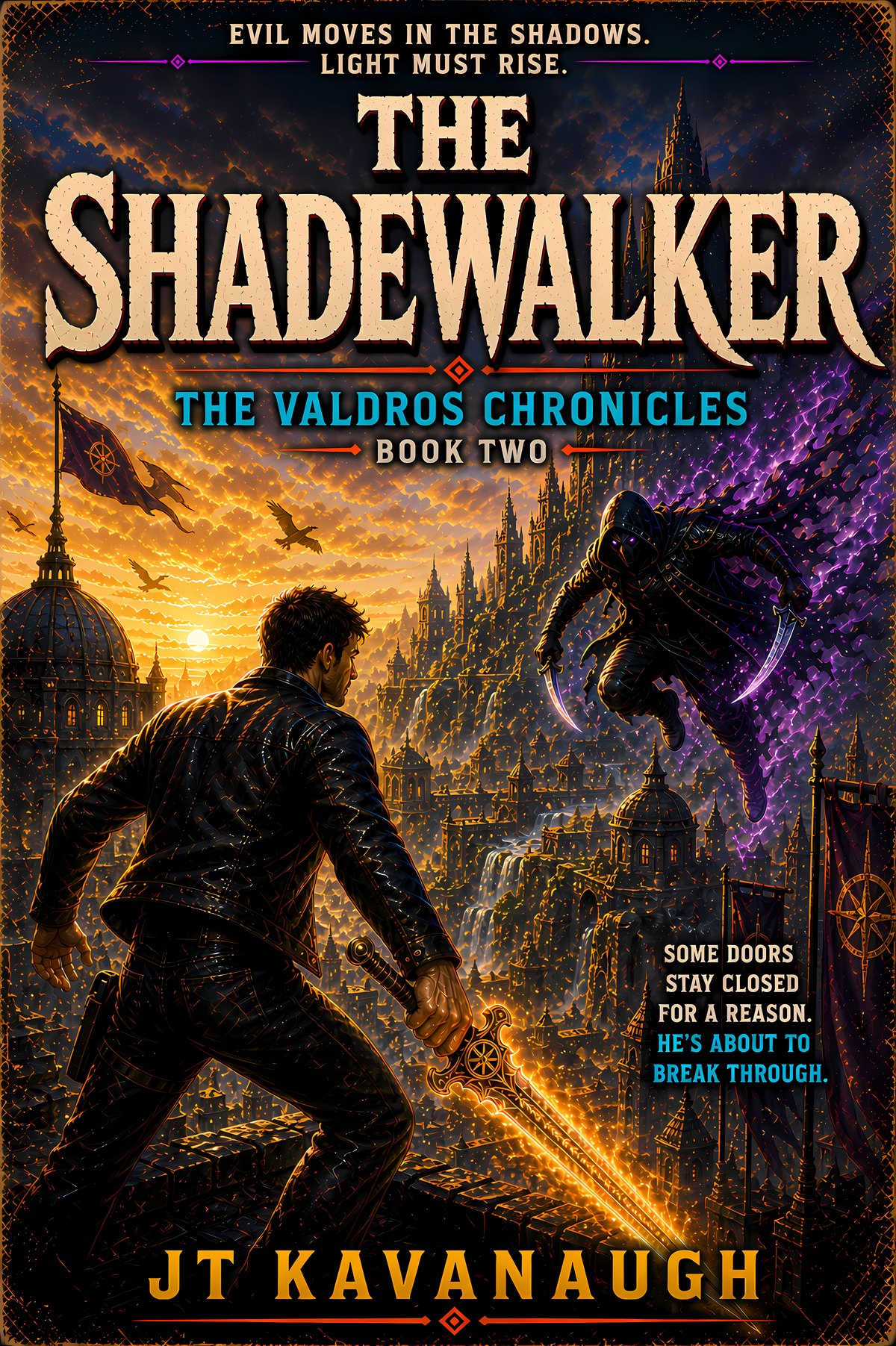
The Shadewalker
Portal Fantasy / Assassin Hunt
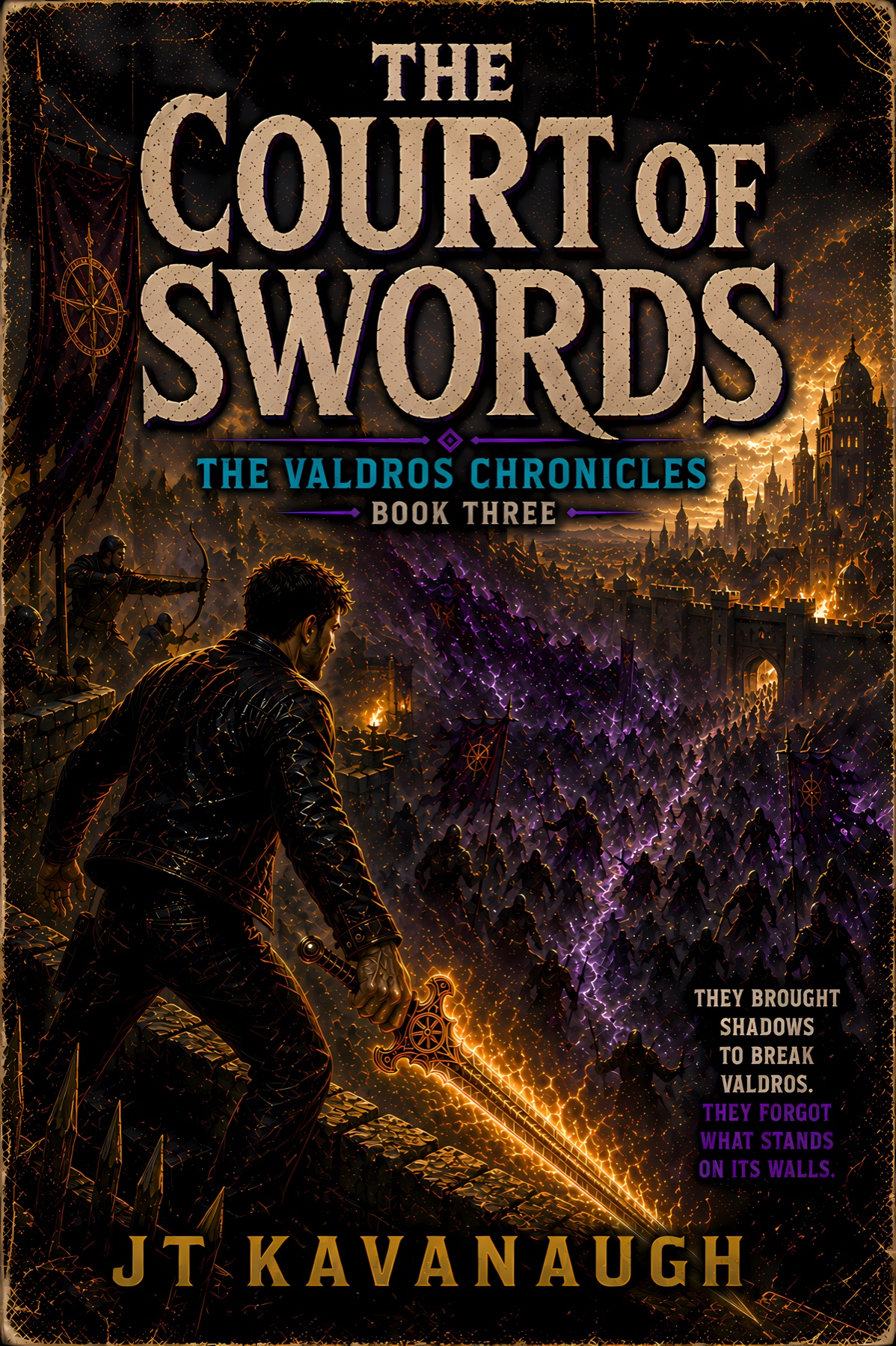
Portal Fantasy / Siege of Valdros
Shadows have come to break Valdros, and Jake Morrow must stand on its walls with a legendary sword and everything left to lose.
by JT Kavanaugh
reader promise
Shadows have come to break Valdros, and Jake Morrow must stand on its walls with a legendary sword and everything left to lose.
cover copy
They brought shadows to break Valdros.
They forgot what stands on its walls.
Jake Morrow has survived the wrong world, the Shadewalker, and the impossible weight of becoming a symbol. Now the war for Valdros rises to the walls, where armies gather beneath burning skies and every old enemy comes sharpened for the throne.
With a legendary blade in his hand and a kingdom looking to him for answers, Jake must face the kind of battle no plumber from Ohio was ever supposed to survive.
Court of Swords is book three of The Valdros Chronicles, a portal fantasy adventure built for readers who want glowing blades, dark citadels, impossible odds, and heroic sword-and-sorcery spectacle.
sample chapters
Formatted for comfortable reading on desktop and mobile.
The horn from the south wall was three short notes — the register that sat between alarm and welcome, meaning neither one.
Jake set his cup down. The tea was bad and he wasn't going to miss it.
"Twelve at the gate," Mereth said, coming through the door without knocking. She never did. "Banner says broken wheel. They want to talk to you."
"Of course they do."
He took the stairs two at a time and came out into the gate yard with his coat still half on. The sky was that flat color that meant it had finished thinking about rain and decided against it. Stonegrave was already there, one shoulder against the gate post, arms folded. The bandage on his forearm had blood on it but the blood was old. Lyra stood three steps off and a little to the side, where you'd put yourself if you wanted to be able to move on two of the three directions a problem could come from.
Through the murder slot Jake counted them.
Twelve men. No, eleven and a man in front. Eight set out across the road in a loose arc, not a clump. The four nearest the gate had stacked their long blades against the wall in a neat row, points down, and were standing with their hands visible. The man in front was compact, mid-forties, gray at the temples, eyes that moved over the wall and the gate and the slits without lingering on any of them. He wasn't trying to look at ease. He just was at ease, in the way of someone who'd been at gates before.
Jake read them the way he'd read a crew showing up to bid a job back home. There were always twelve guys on a site. Two of them knew what they were doing. Three of them looked like they did. The rest were going to be told. He worked out which two these were before he worked out the rest.
"They've stacked," Stonegrave said.
"I saw."
"Spread, not bunched."
"Saw that too."
"Professionals."
"Yeah."
Jake nodded at the gate sergeant. The bar came up. Jake went through with Lyra a half step back and Stonegrave a full step. He kept his hands loose. Soulblade was a weight at his hip that hadn't warmed.
The man in front did not bow. That was the first useful thing about him.
"Champion."
"You know who I am. I don't know who you are."
"Rennick. Oshen's second column, eastern bank. Was."
"Was."
"Oshen is dead. Drakken put him down four nights ago in his own field tent. We weren't there. Wouldn't have changed it if we had been." He said it without heat. "His house is broken. His pay is over. The men with me have families that still need to eat. We came north because Varethon is still standing and we heard the Champion does not Bind."
"You heard correctly."
"Then we're asking for work. We don't expect trust. We expect to be put somewhere we can be useful and watched from behind until we earn the other thing. We brought our own blades. We won't carry yours yet."
Jake looked at the eight in the road. None of them had moved. One of them, a woman with a scar that went from her ear down into her collar, met his eyes and held them for exactly the time it took to be polite and then looked at the middle distance again. Disciplined.
"Four come in," Jake said. "Eight wait in the yard outside the gate. We feed all twelve. We talk inside about where you go."
"That's fair."
"Hand weapons stay stacked until I say otherwise."
"That's fair too."
Rennick turned and made a small motion with two fingers. Four men separated from the road and walked in past the gate with the unhurried tempo of people who had done this before for a living. The other eight stayed where they were.
Jake was turning to bring them in when he caught it out of the corner of his eye — Rennick, already up on the gate-yard wall, not following, watching the road south. He'd put himself there without being told. That alone was worth a week of letters of reference.
"Champion." Quiet voice. Not a shout.
Jake came back. "Yeah."
"Movement on the south approach. The Orrith delegation. You knew they were coming?"
"In the next hour."
"They're early by twenty minutes." Rennick's eyes hadn't moved from the road. "And they brought six."
"Protocol says two."
"I know what protocol says. I was on a Council escort once, years ago. We were two."
Jake came up onto the wall walk beside him. Down the road, banners — the green and gray bar of House Orrith, Cashen's family arms. Two riders in front, six on foot behind. The riders he'd expected. The six he hadn't.
Rennick said, "Third attendant from the left. Brown coat. You see him?"
"I see him."
"Look at the hem. The cuff."
Jake looked. There was a stitched pattern running along the cuff and the hem of the coat, a small repeating thing, two angles and a bar. Not the green-and-gray of Orrith.
"That's not Cashen's household mark," Rennick said. "I've seen it twice. Once when Lord Dreen's succession was sorting itself out and three of his nephews stopped breathing inside a month. Once when a supply route in the western valleys changed hands without an authorized signature. Both times Morveth was in the vicinity. I never saw her. I saw that mark, twice, and afterwards I heard the name."
He said it like a man delivering a piece of mail. No flourish.
Jake watched the attendant in the brown coat. The man walked with the particular economy of someone trying to look like he wasn't paying attention to the wall.
"You're sure."
"I'm sure of the mark. I'm not sure what it means here. But it's the same mark."
"Stonegrave."
"Here." From the gate below.
"Bring Rennick's four through. Give them food. Keep them in the lower hall. Rennick walks with me."
"Through the gate?"
"Around it." Jake turned to Rennick. "How fast can you cut the inner stair without being seen?"
"From here? Two minutes. Maybe less."
"Go."
Rennick was off the wall before Jake had finished the word.
The Orrith delegation came in through the south gate with all the small theater of a formal arrival — Cashen on horseback, his second on horseback, four soldiers, two attendants on foot, a clerk with a satchel. Mereth received them in the front court. She was the right person for it. A delegation needed to feel both welcomed and inspected at the same time, and she managed both without appearing to try. Jake watched from the colonnade above for exactly the time it took to confirm what he was looking at.
The attendant in the brown coat stayed at the back of the group. Eyes down. Hands folded in front of him. The clerk was talking to Cashen's second. The soldiers were being formal. The brown-coated man was being invisible, and being invisible badly. In a delegation, everyone had a job. He had none.
The court emptied into the receiving hall. The attendant did not follow.
He turned left, into the corridor that ran along the outside of the receiving hall, the one with the service door at the far end.
Jake came down the inner stair in long strides. He didn't run. Running in corridors made noise and pulled eyes. He walked fast, the way a man walks when he is on his way to do something he is allowed to do.
He came into the side corridor at the same time the attendant did, from opposite ends.
The attendant saw him. The man's face sealed. A beat, then he turned and walked the other direction. Fast but not running.
Jake matched his pace.
The corridor jogged left at the storeroom. The attendant took it. Jake took it three seconds behind him. The corridor opened into the kitchen yard, then narrowed again into the service passage that ran along the back of the receiving hall, then forked — left into the laundry, right toward the stables.
The attendant went right.
The attendant went right and stopped. Rennick was standing in the passage with his arms folded and his back against the wall, looking like a man who had been given a position and not a reason.
"Sir," Rennick said politely.
The attendant turned around. Jake was at the other end of the passage. The attendant's hand went to his coat. Not for a weapon. Higher. Inside pocket.
"Don't," Jake said.
The attendant didn't.
"Hand out of the coat. Slow."
The hand came out. Empty.
"Other one."
That one came out too.
"Coat off."
The coat came off. The attendant did not look at either of them. He fixed his eyes on the wall above Jake's left shoulder and gave his face nothing to do.
Rennick took two steps in and went through the coat with the practiced indifference of a man who had searched a great many coats and found a great many things. Inner pocket, left. Inner pocket, right. Lining seam. Sleeve.
He came out of the lining seam with a brass tube the length of his palm, sealed with red wax.
He held it up so Jake could see it. The wax had no impression in it. Blank seal. The kind you used when you didn't want anyone reading the wax to know whose office it had left.
"Watch room," Jake said.
Mereth was already coming down the corridor — she had a particular instinct for being where things had just stopped happening. Two of her guards were behind her. She took the brass tube without saying anything and turned it over in her hands, looking at the seal, the weight, the resin. She broke it with her thumbnail and slid out a folded slip of paper.
She read it.
Her face did the thing her face did when she was deciding whether to share information now or later. She decided now.
"It's a tally," she said. "Today's outgoing distribution. Grain to the south district, oil to the wall lamps, the resupply schedule for the watch towers through tomorrow night. With the timings."
"Timings."
"To the half hour."
"That isn't political intelligence."
"No. It's siege intelligence. It's the kind of thing you write down if you want to know exactly when a city is at its lowest on lamp oil and watch rotations."
Jake looked at the attendant.
The attendant looked at the wall above Jake's left shoulder.
"Watch room," Jake said again, quieter. "Don't put him in with anyone else. Don't let anyone from the Orrith delegation know we have him. As far as their clerk is concerned, this man got lost on the way to the privy."
Mereth's guards moved. The attendant went with them without a word. He'd been expecting this since before they'd walked in the door.
Mereth, after a beat, looking at the empty corridor where her guards had gone: "He didn't even argue."
"No."
"I had a speech ready."
"Save it."
When they were gone, Rennick said, "She's in the building."
"Morveth."
"Or close enough that she planted that and expected to read what came back. She's counting."
"Counting what."
"Us. How many we have. How much oil. When the watch turns. She's putting the math together for someone." Rennick looked at the brass tube still in Mereth's hand. "She started before this delegation arrived. She always does. She's already a week into her clock and we just found out there's a clock."
Jake took a breath that didn't go all the way down. The corridor smelled like soap from the laundry, and stone, and the faint copper of the old keep's plumbing, which he'd fixed in three places and would probably end up fixing in three more.
"Welcome to Varethon," he said to Rennick. "Your first job is the wall walk. South. Take two of your people. Tell me what you see that I'm not seeing."
"Yes, Champion."
"Jake."
"Yes, Jake."
Rennick went. Jake stood in the corridor with Mereth and the empty brass tube. Down the hall he could hear Cashen of Orrith being offered wine — the formal tone of it, gracious nothing. He didn't go in.
Somewhere in the building, or close enough to read what came back, a woman was counting.
Jake found Zynn in the room he had taken over for his work, which was nominally the small library off the east cloister and was now mostly Zynn. Books on the floor in stacks Jake didn't pretend to understand. Three lamps. A brazier kept low. Zynn's leg didn't like cold. Zynn himself was at the table with his bad arm in a sling and his good hand turning a page with the patience of a man for whom each page was a small negotiation.
"I have a thing," Jake said.
"You always have a thing."
Jake set the shard down on the table between them.
It was a piece of the Shadewalker's mask, dark, slightly curved, the size of his thumb. Inside the curve, faint, the two letters: T. M.
For a second his father's face was in his head — the version from a photograph on his mother's dresser, half-turned, mid-sentence to somebody outside the frame. Jake put the photograph back where it lived. Practical problem on the table. He looked at the shard.
Zynn went still in the specific way he went still when he wanted to look without his hands getting ahead of his eyes.
"Light, please."
Jake moved a lamp. Zynn brought a glass on a brass handle out of a drawer and held it over the shard at three different distances until he was satisfied with one.
"It is not a maker's mark," Zynn said.
"How do you know."
"A maker's mark is laid down in the original casting. It's in the material. This was added after. You can see the bead pattern along the edge — that's how aether-bonded ink sits when it's etched into a finished surface. The substrate was already cured when the letters went on."
"Aether-bonded."
"Mid-royal era technique. Out of use for sixty years. You can apply it without heat, which is the point — you can mark something already in service without disturbing it. The royal records office used it for witness marks on contested documents."
"Witness marks."
"A witness mark says: I was here, I saw this, I want the next competent person who finds it to know." Zynn looked up. "It is not a signature on a thing the marker made. It's a flag on a thing the marker found."
Jake put his hand flat on the table because if he didn't he might do something with it that didn't help.
"Found," he said.
"Found. Sealed. Wanted somebody else to know about, later, when the conditions for safe knowing existed." Zynn pushed the glass aside. "Whose initials, Jake."
"Thomas Morrow."
Zynn's mouth did a small thing that was almost a smile and was actually something more careful.
"Your father left himself, in writing, inside the mask of the thing that almost killed you."
"Yeah."
"That is a great deal of confidence in his son."
"Or a great deal of being out of options."
"Those are not always different."
Jake picked the shard back up.
"I'm taking it to Talon."
"You are taking it to Talon," Zynn said, "because Talon is the only person in this building who knew Thomas Morrow well enough to translate the shorthand. I think you should take it. I also think you should sit down for at least one meal before you do."
"After."
"After. Of course."
Jake was at the door when Zynn said, without looking up, "Jake. He left it for you to find. Whatever else is true, that part is true."
"Yeah," Jake said. "I noticed."
The room he chose was small and had one lamp. Anything else would have been a performance. Talon was already in it. The cup beside him had gone cold. Half an hour, maybe. The shoulder was bad today. Jake could see it in the way Talon kept the arm tucked.
Jake set the shard on the table between them and stepped back. He did not sit. Talon was a man whose information came faster if you gave him room.
Talon looked at it for a long time. Long enough that the lamp's flame moved twice in the draft from the corridor.
"Where," he said.
"Inside the mask. Curved part. Right where the breath would have come out, if it had breathed."
"You broke the mask with the blade."
"With the ground. Not with the blade."
"Yes. I remember the distinction."
Talon picked the shard up with two fingers, carefully, the way you picked up a thing you already knew the weight of from having imagined it for years.
"He found something," Talon said.
"I figured."
"Below the Citadel. In the sub-Citadel infrastructure that nobody charted because by the time anyone thought to chart it the people who would have known were dead." Talon set the shard down. "It was a binding mechanism. Built into the stone work. He couldn't tell at first what it was binding. He worked at it for months. What he eventually understood was that it was accumulating Primeforce drawn up from below the Citadel. Not using it. Storing it. Building a reserve."
"For what."
"He couldn't trace it. The output paths went into council seal authorizations a generation old. Authorizations that should not have existed and which the council itself didn't remember granting. Whoever had built it had used the council's own architecture. Patiently. Over fifty years. He estimated fifty years. The work was that careful. Whoever it was understood the Citadel's detection systems from the inside and had built around them deliberately."
Jake said nothing.
"He couldn't identify the builder safely. Any direct inquiry would have tipped them off. So he did two things. He sealed the cistern with the means he had — Soulblade access only, Crown witness. He left himself in writing on the seal so that the next holder of the blade would know a man had been there before them and had chosen not to open it."
"And took me to Earth."
"Yes."
Jake waited.
"Whatever the mechanism was being built for, it involved the Crown. He couldn't tell exactly how. He could tell it involved the Crown Prince. The safest thing he could think of, with the time he had, was to put you where the mechanism could not reach you while he figured the rest of it out."
"Did he figure the rest of it out."
"No. He died before he could."
Jake's hand was flat on the table again. He noticed it and took it off the table and put it in his pocket.
"He should have stayed," Jake said. Flat. Not angry. He was just saying what the math was.
Talon did not answer.
Jake didn't need an answer. He'd just been saying what the math was.
The lamp moved in the draft again. Down the corridor, someone laughed once, briefly, and was quiet.
"There's more," Talon said.
"Yeah."
"But you've had enough for one room."
"Yeah."
Talon picked the shard up again and looked at the letters on the inside of the curve. Whatever was in his face had been there for twenty years and was tired of being carried but didn't know any other posture.
"He bet on you," Talon said quietly. "He bet that without formal training of the blade you would find your way to the cistern by accident or by trouble. He bet you would use the blade wrong — meaning not the way it was designed to be used, meaning the way the mechanism was not built to accept. He bet you would destroy rather than open. He was right."
"I drove it into the door frame."
"I know. That is what he meant."
Jake took the shard back and put it in his coat pocket.
"One more thing," Talon said. "Before you go."
"Yeah."
"Vashen."
"Who."
"A surviving Royal Council member. Vashen of Pareth. He's in the building. He arrived six days ago. Two days before the first delegation. He has not approached me. He has not approached Mereth. He has been in his room or on the walls or in the corridors looking at nothing in particular. He's been here waiting for something to start."
"What."
"I don't know yet. I think you should find out."
Jake stood there with his hand on the door.
"He was on the council when my father was."
"Yes."
"Then he knows."
"He knows some of it. How much, I don't know. He's the only one of them left who would."
Jake nodded once and went out.
He went back to the command hall.
Rennick fell in beside Jake on the wall walk at the south corner, where Jake had stopped to look at the approach road and pretend he was thinking about something other than the south approach road.
"He doesn't go to the meeting rooms," Rennick said.
"Tell me."
"I picked him up at the east wing this morning when he came out for breakfast. He didn't take breakfast. He took a cup of water from the well in the small court and stood there with it for about a minute and then poured half of it out and walked. He went to the second floor of the central block. The supply distribution office."
"Did he go in."
"No. He stood outside it. Six minutes. I counted. There's a bench in the corridor opposite the door. He didn't sit on it. He stood. He looked at the door. He didn't try the handle. He didn't speak to the clerk who passed him going in. After six minutes he turned around and left."
"And then."
"Then he came up here. South wall walk. About forty paces east of where we are now. He stood there a long time looking at the approach road. Not at the gate. At the road. The way an engineer comes back to something he built ten years ago, making sure it's still where he left it."
Jake breathed out through his nose. The wind was up. It smelled like the river.
"He wasn't looking at the meeting rooms."
"No."
"He was looking at the supply office and the approach road."
"Yes."
"Those are the two things Morveth's clerk would be writing down."
"Yes."
"He's not here for the politics."
"He's here for whatever the politics are cover for."
Jake stood there a minute. He could see the approach road from where he was. It came up out of the valley in a long curve, two switchbacks, and then ran straight at the south gate across about four hundred yards of open ground. There was a drainage cut on the eastern side that the water followed when the rains were bad. He had spent more time looking at that cut than at any other piece of geography in the city. That was where you put a sapper. It was also where you would put a man with a portable shadow generator if you wanted him close enough to the wall to matter and unseen by the wall lamps.
"Stay on him," Jake said. "Until he sleeps. When he sleeps, sleep. When he gets up, get up. Don't let him notice you. If you have to choose between not being noticed and not losing him, lose him. Don't burn yourself yet."
"Yes."
"Where is he now."
"Back in his room. Door closed. He's been there forty minutes."
"All right. Go."
Rennick went.
Zynn was in the doorway of the command hall when Jake came in. He had a ledger open across his good arm. Stonegrave was behind him, filling the rest of the doorway, looking at the ledger over Zynn's shoulder like a man who'd had a number explained to him and didn't see why anyone had needed to explain it.
"The clerk," Zynn said.
"Which clerk."
"Outgoing supply distribution, central office, second floor. The man at the desk closest to the window."
"What about him."
"He's been shaving numbers."
Zynn turned the ledger around and put it on the map table. He used his good hand to flatten the page. Jake came around to look.
The page was a tally column with dates running down the left margin and quantities in the middle and a running total on the right. Zynn had pencil marks beside certain lines.
"Six days," Zynn said. "Six days that don't reconcile. Each day the outgoing tally is short of the warehouse count by between two and five percent. Small. Within the noise of normal pilferage and waste. Except —"
"Except all six are short the same way."
"All six. And on three of those six the outgoing report describes a shortage. He's writing a shortage that isn't there. He's reporting that we're running thinner than we are."
Jake looked at the column.
"Stonegrave saw it."
"I was on the wall," Stonegrave said. His voice came from somewhere down around his ribs. "Watch lamps were lit ten minutes early one night. I noticed. I asked the lamp captain why. He said the oil ration had been short and they'd lit early because the oil they had was low-grade and burned faster. I checked the oil. The oil was fine. The ration that day was the same as every day. He'd been told it was short. Somebody had told him."
"The clerk told him."
"The clerk is the one who writes the rations down."
"Then the lamp captain reports a shortage that isn't a shortage."
"And the outgoing tally goes out with a number shaved off the top to back the shortage up. So if you were sitting somewhere reading those tallies —"
"You'd calculate the city is six days closer to running out than it actually is."
"Yes."
"And you'd time your assault to land at that point."
"Yes."
Jake stood with his hands on the edge of the map table. The wood was old. Some of the gouges in it were from his own knife the time he'd had to demonstrate a drain angle.
"He's there now."
"At his desk. I sent a runner past five minutes ago to confirm."
"Stonegrave. Lyra. Zynn. With me. Quiet."
The supply distribution office was on the second floor of the central block, at the end of a corridor that ran along the inside of the south face. Three desks in a long room. Tall narrow windows. The light came in pale and steady through the south windows. The south wall was thick enough to slow the sun down.
The clerk at the third desk had his head bent over a ledger. He had ink on his second finger. His hair was thinning at the crown in the way of men in their thirties who had not yet given up on the idea of doing something about it. He did not look up when the door opened. Two other clerks at the other desks looked up.
Jake knew the shape of him. There had been a contractor on the Dublin Road job who'd double-billed for copper for six months before anyone caught it. Same posture. Same ink on the same finger. The trick was always the same trick — small enough numbers, often enough days, betting nobody added the columns sideways. Somebody always added the columns sideways eventually.
"Out," Mereth said from behind Jake. He hadn't known she'd come. She'd come.
The two other clerks went out.
The door was not built for Stonegrave going forward. He stepped in sideways and closed it behind him with the back of his hand. Lyra moved without being told to the inside wall, between the clerk and the only other exit, which was a service door that opened into a stair down. Zynn came in last and went to the ledger on the third desk and laid his good hand flat on it before the clerk could move it.
The clerk looked up.
He was thin. Long face. Wool. Forgettable in every detail, which Jake thought was probably the point.
"Page forty-one," Zynn said. "Lower third. The line for lamp oil to the eastern wall stations on the night of the fourth."
The clerk looked at the page.
"That number," Zynn said, "doesn't match the warehouse receipt for the same date."
"I —"
"I have the warehouse receipt in the next room with a runner. Would you like me to bring it."
The clerk said nothing.
"And the line above it," Zynn said. "Grain to the south district, third of the month. Doesn't match either. And the line three above that. We have six. We can sit here, if you like. I have the rest of the afternoon."
The clerk looked at Lyra. Lyra was leaning, slightly, against the inside wall, with her bad arm in close and her good arm loose, and her eyes on the service door, not on him. She wasn't pretending he wasn't there. She just knew that if he moved she would see it in the door without having to look at him.
The clerk looked at Stonegrave. Stonegrave looked back at him without any particular emotion. He was so much larger than the clerk that they were not quite the same kind of thing.
The clerk looked at Jake.
Jake said, "Stand up."
The clerk stood up.
"Hands on the desk."
The hands went on the desk.
"How long."
"How long what."
"How long have you been shaving the numbers."
The clerk let out a breath he had been holding for what looked like the entire conversation and possibly the entire week.
"Three months."
"Who."
"A woman. I don't know her name. She came once. She gave me money the first time. After that she sent a man with a brass tube every eight days. I'd put the new figures in the tube. I'd leave the tube under the third bench in the lower south arcade. I never saw the man pick it up. I'd come back the next morning and the tube would be gone."
"Last drop."
"Three days ago."
"Next drop."
"Tonight."
Mereth, behind Jake: "Watch room."
The clerk nodded. He didn't say anything else. He didn't argue. He didn't try the service door. He didn't go for anything in his desk. He let Stonegrave's hand fall on his shoulder and he walked between Stonegrave and one of Mereth's guards out into the corridor with the particular gait of a man who had been imagining this morning for three months and was almost relieved to be done imagining it.
When he was gone, Zynn closed the ledger.
"He's not a fighter."
"No."
"He's an accountant who made a decision."
"Yes."
"He knew the day would come."
"Most of them do."
Jake stood at the third desk for a moment. The clerk had a small clay cup of water on the corner of the desk. Still half full. He'd refilled it that morning. He wouldn't finish it.
Zynn, behind him, picking up the ledger: "He has very neat handwriting. For a traitor. I would have expected worse handwriting."
"Zynn."
"I am only making the observation."
Stonegrave from the doorway: "Don't."
"Right."
Jake looked out the south window.
From there he could see, on the wall walk above the south gate, a figure with gray at the temples, standing very still, looking at the approach road. Vashen had come back out.
Two threads in one building. The man on the wall, watching the road. The man going to the watch room, who had been counting their grain.
And the woman who had positioned both of them, somewhere in this building or near enough to it to read what came back, who had been here longer than the delegations had.
"All right," Jake said, to the window, to himself, to none of them in particular. "All right."
The three delegations arrived inside two hours of each other and a child could have read the schedule. Orrith had come in the morning. Skarn at midday. Brell late afternoon. Someone had written the timing. Someone had given each of them just enough lead and just enough lag to make sure they didn't talk to each other before they got inside the walls.
Mereth handed Jake the gate report at the bottom of the south stair. He read it walking.
"All three," she said.
"All three."
"Brell's herald has already filed the demand."
"Tell me."
"Public demonstration. Arena. Tomorrow morning. The formal language is about reassuring the delegations that the city's claim of a Champion is supported by the Champion's continued capacity. The informal language is that they want to see you fight."
"They want to see me change."
"They want to see you change."
"Yeah."
Jake folded the gate report and put it in his coat.
"Tell Talon," he said. "Tell Lyra. Tell the arena keeper to clear the lower benches and post Rennick's people on the upper. I'll be in my room."
"Eating?"
"Thinking."
"Eat while you think."
"Yes, mother."
The corner of her mouth moved. Almost.
He didn't sleep well. He had not expected to.
He sat with his back against the wall and ran the problem.
Open sky. No ceiling. No sealed room. The arena floor was sand over packed earth. The walls were stone but only twelve feet high before the lower benches started. Above the lower benches the city's east face dropped away into open country. From the eastern hills, with a glass, a competent scout would see anything that happened in the bowl from the chest up.
Drakken had scouts on the eastern hills. He had had scouts on the eastern hills for two weeks. Jake had walked the line three times in the dark and watched their fires move and counted them and learned their rotations. He knew where they were. They knew where he was. They were not yet shooting at each other. Both sides were still pretending this was politics.
If he changed in the arena, the scouts would see the change. They would see the moment it happened, how it happened, the duration, the tell. They would map it. They would carry it back. By the time the assault came, Drakken would have notes on the Champion the way you had notes on a weapon — what triggered it, how long it ran, where its edges were.
Jake was not afraid to change. He was unwilling to hand Drakken a manual.
He turned the problem over and looked at it from the other side.
If he did not change, the delegations would write down doubt. They had come here for doubt. They would get it. They would carry that doubt back to their councils and their councils would calibrate, and the political weight of Varethon would be smaller in their meetings by exactly the difference between the Champion they had hoped for and the man they had seen.
He could not stop the doubt from being written. But he could choose what else went down on the page with it.
He went to sleep.
The soulblade stayed cool.
The arena was full by the time Jake came in through the lower iron door. Three delegations on the south benches in their assigned blocks, each with its herald and its clerk and its observers. The middle benches had Mereth's people and the watch officers and a thin scattering of citizens who had turned up to watch. Their city was doing something formal. The upper benches were Rennick's now. Jake didn't look at them. He didn't need to. Rennick had walked the upper line at dawn and laid out his eight in the four positions where a man with a thrown blade could in theory reach the arena floor.
The herald said his words. The crowd settled.
The first two guards came out from the opposite door, sequential, the way the formal pattern required. Two of Mereth's regulars. Jake knew their names. They were not here to lose to him. They were here to fight him properly.
The first one came in straight and committed. Jake stepped off the line, took the man's wrist as it went past, used the man's own forward weight to put him on the sand. Done in under a second. Clean. The second one had watched the first and adjusted. He came in slower, on an angle, blade low. Jake gave ground twice, made the man chase, and on the third step the man's lead foot was where Jake had wanted it and Jake's knee went into the back of the man's lead knee and the man went down sideways.
The crowd applauded. Not the heavy applause. The applause for a skilled fighter doing skilled work.
Jake stood breathing easy on the sand. He looked up at the south benches.
The delegations were watching. Cashen of Orrith with his hands folded in his lap. Brell's herald taking notes. Skarn's observer sitting with his eyes half closed in a way Jake recognized as a man counting tempo.
The iron door opened again. Four guards came out.
Lyra came out with them.
She had not been called. She had come down the lower stair without speaking to anyone and walked out onto the sand on Jake's side, and she stood there now with her sword low and her bad arm in close and her eyes already on the four. Jake did not look at her. He did not need to send her away. She had decided.
He took the two on his left. She would have given him those. She took the two on her right. He would have given her those.
They worked it without signals.
This was the part of the morning that the crowd would talk about that evening. Not the change that didn't come — the change that didn't come would come later in the conversation, with the wine. This part, the part with the four and the angles, was the part that quieted the crowd while it was happening. They were watching two people who had spent so many months in the same training spaces that the other's movement had become information they already had.
Jake took the inside man with a redirect and put him into the path of the outside man and stepped through. Lyra had already moved to where the outside man was going to be when he got there. She put him down with the flat of the blade across the side of the head. Her wrist was that good. The third man came at Jake low and Jake gave him the redirect Lyra had taught him in the third week he had been here, the one he had never been able to do cleanly until about a month ago. He did it cleanly. The fourth man tried to take Lyra from her bad side and she pivoted off her good leg and her blade came up under his guard and tapped, twice, in the two places that meant if she had wanted it to be a tap and a cut it would have been.
Four down. The sand barely disturbed.
The crowd came up to its feet in the upper benches. The south benches did not stand. The south benches were watching with the close attention of people who had just been shown something they had not expected to be shown and were trying to write down what it had cost.
Lyra stepped back to the wall without looking at him. Jake did not look at her either. The arrangement was already understood.
The iron door opened. Four more came out.
These four had been briefed between rounds. Jake could see it in their posture — weight back, blades higher, no commitment to the first step. Conservative. Drakken's scouts on the eastern hills, if they were good, were also seeing it.
The four spread. Jake moved.
He took the first one with the redirect again. It worked. He wasn't in the business of inventing new tools when the old ones were doing the job. Number two came in with a thrust at his middle and Jake stepped inside it and put an elbow into the man's nose and the man sat down. Number three was on Jake's left and went for the left side. He'd been told to find it. Jake took the hit.
The ribs.
The ribs from Book Two, the ones that had not quite finished, lit up under his coat in the particular way that meant a thing he had been pretending was healed had not actually been healed.
Jake did not change.
He stepped through it. Fourth man, already inside his range — a man who stopped now because of a rib stopped because of every rib for the rest of his life. Jake caught the blade on the outside of his own, twisted hard, and the sword left. The man sat down and put his hands up.
Number three was still on his feet. Jake came back to him with the cold patience of a man who had a rib to thank for the next thirty seconds of accuracy. He put number three down with two clean strikes to the inside of the leg.
Eight on the sand. None of them dead. All of them done.
Jake stood in the middle of the bowl and breathed through his teeth.
The crowd came up. The upper benches and most of the middle. Standing ovation. The south benches stood last and least. Protocol required it. They did the minimum.
And then the man two seats behind Cashen of Orrith stood up.
He was a small man with sandy hair and an academic's gentle face. Jake didn't know him by name. He was on Brell's papers as an observer. He stood with his hands resting on the rail in front of him and he waited until the ovation had thinned enough that he could be heard without raising his voice.
"Champion," he said. "Forgive the question. We have not seen the transformation today. Can the Champion tell us why?"
Genuine curiosity. That was worse than hostile. Jake couldn't push back without making it look like he had something to push back on.
Jake looked up at him.
He let the silence go a beat. Two beats. He felt the eye of every clerk in the south benches on the corner of his mouth, waiting for a tell.
"Because it isn't a performance," he said.
He said it flat. He didn't raise his voice. He didn't smile. He didn't soften it.
The man with sandy hair sat down again, slowly. Not satisfied. Not insulted. Exactly what he'd expected, and not glad about it.
The delegations settled. They had what they came for. They'd write it down tonight.
Jake walked off the sand. Lyra fell in beside him at the iron door. Behind him, on the upper benches, Rennick's people came down off the four positions they had taken before dawn, unhurried. The immediate problem was over. The longer problem had just gotten longer.
Outside the iron door, in the cool stone of the under-arena, Lyra said, "That was the right answer."
"Then why does it feel like a loss."
"Because it was both."
She kept walking. Jake kept up.
Jake's rib lit up again under his coat. He kept walking too.
The private room in the east wing had two chairs, a window with the shutter half closed, and the particular smell of a room nobody had used hard in a while. Vashen was standing when Jake came in. He had positioned himself near the inside wall, slightly off the center, with the window at his right shoulder. The pose of a man who had not sat in unfamiliar rooms in many years.
Jake sat.
He took the chair nearest the door and let his coat fall open and put his hands on his knees and waited. If Vashen wanted to stand, Vashen could stand. Jake had a rib that didn't want him standing and Vashen was a man for whom posture was tactical, and Jake was not going to compete on that ground. He didn't need to.
Vashen looked at him.
He was older than Jake had expected. Jake had been told the man's age. The years showed differently on him than the number had suggested. He was thin. He had the long fingers of someone who had spent a life writing. The gray at his temples was the kind that had come in slow and had been there a long time.
"Champion."
"Jake."
"Jake." He said it the way a man tried out a word in a language he was learning. "I have been in this building for seven days."
"I know."
"I expected you to come find me earlier than this."
"I expected to come find you earlier than this. The week got busy."
"Yes." Vashen looked at the shuttered window for a moment, as if it were the source of a sound he had heard. "I needed to see this place before people stopped letting me see it clearly. After the first delegation arrived, I would have been read as a piece on the board. Before they arrived, I was a piece off the board who could still walk into rooms."
"That isn't an apology."
"No. It is a description."
"Go on."
Vashen sat down. He did it carefully, in a way that did not commit fully to the chair. He kept his weight forward.
"I have been providing information to Morveth's network for the better part of two years," he said. "Not orders. Not the full scope of anything. Names of councils that no longer exist. Procedural information about how the old council moved papers. Names of dead men. Locations of records offices. The shape of the architecture, not the contents. She told me she was rebuilding institutional memory for the western houses. I knew that was a partial truth. I told myself it was enough of a truth."
"And."
"Three days ago I stopped responding to her drops."
"Why."
"Because the drops had stopped being about institutional memory and started being about Varethon."
"Does she know."
"Not yet. She will when this is over."
"Did she send anybody after you."
"No. She is the kind of operator who does not chase a piece that has stopped moving. She replaces it. She has already replaced me. I am sure of it. I just don't know with whom."
Jake watched him.
"You came here to see Varethon before it was attacked."
"I came here to see it before it was attacked. And I came here because I thought, if I stood inside the walls of the place she was about to hurt, I might find the will to stop being useful to her in the small ways I had still been useful by being silent."
"That's a lot of architecture to put around the word guilty."
"Yes. It is." Vashen looked at him squarely for the first time. "I was afraid for a long time. I'm telling you the truth now because I'm done being afraid of it."
Jake let it sit. He waited.
Vashen reached inside his coat and brought out a folded document. He laid it on the table between them. Two pages. Faintly waxed paper. The seal at the top was a sigil Jake didn't recognize and Vashen didn't explain.
"Forward element movement orders," Vashen said. "From the field. Eleven days old when they were written. I received them through a chain that I will not describe to you, because the chain still has people in it who can be saved if they are not yet identified. I will describe what is in them."
"Go ahead."
"Your scouts are watching Drakken's rear units. The rear units are real. They are where you think they are. The advance elements are not where you think they are. They are two days closer than the reports you have been receiving from your eastern line."
"Two days."
"At least two days. Maybe less. Maybe less, by now, given that this document is two days old in my hand."
Jake picked it up. He read it. He read it again. The orders were terse and the names of officers in them were ones he had seen on captured rosters from earlier in the year. He read the numbers, the positions, the timings. Vashen sat very still and let him read.
"The supply clerk," Jake said.
"Yes."
"You know about him."
"I know he exists. I know he was placed in your distribution office before I arrived. I know he is one of hers. I do not know the contents of his drops because his drops do not go through my chain. He is on the assault planning side. I am on the political memory side. We are not in the same file."
"You knew he was here and you didn't tell anyone."
"I knew he was here and I did not tell anyone. Yes. That is also true."
Jake breathed out.
"Thomas Morrow," he said.
Something moved across Vashen's face. Not guilt — older than that. The face of a man who had been carrying something so long he didn't remember what he'd looked like without it.
"Yes," he said.
"You were on the council with him."
"I was on the council with him."
"You were there when he went below the Citadel."
"I was there when he went below the Citadel. I was one of two men he told."
"Who was the other."
"He is dead now. Has been for sixteen years."
"What did Thomas ask you."
"He asked me to help him identify the builder of the mechanism. Quietly. Outside the official channels. He had narrowed it to a small group of names but he could not move on any of them without exposing himself and the seal he had just laid. He asked me to do the work he could not do."
"And."
"And I delayed. I told him I needed time. I told him the political moment was wrong. I told him I needed to consult the records in two separate offices, both of which I knew would take weeks to access. I gave him every reason a tired man gives when he is afraid to do a thing."
"You were afraid."
"I was afraid."
"Of what."
"Of being the second corpse in a room I did not want to be in even once."
Jake nodded once.
"The coup," Jake said.
"The coup came eight weeks after he asked me. It made the question irrelevant. By the time I was in a position to take the question up again, the men who would have known the names were dead, the offices I had used as my excuse had been burned, and your father was dead. I delayed. Sixteen years. That's what I did with the time he gave me."
Jake folded the document and put it in his coat.
"I am giving you three rules," he said.
"Yes."
"You stay in this building. Not the east wing — the building. You can walk the corridors. You can sit in the common hall. You can eat with my people. You can go on the walls if Mereth puts an escort on you. You do not leave."
"Yes."
"You do not approach Cashen of Orrith's household. You do not exchange words with anyone in Orrith colors. If you need to communicate with the delegation for political cover, you tell Mereth and Mereth does it."
"Yes."
"You do not leave this building without telling Mereth in person. No watch relay. No runner. Her, directly."
"Yes."
"That's the three."
"Yes."
Vashen sat there for a moment with his hands flat on his thighs.
"I know what I did," he said. "I'm not asking you to forgive it."
"Yeah," Jake said. "It usually is."
He got up. The rib protested. He did not give it the satisfaction of a sound.
At the door he stopped.
"One thing," he said.
"Yes."
"My father. When he asked you. Did he know you would delay."
Vashen took a long time to answer.
"I think he hoped I would not," he said finally. "I think he suspected I might. I think he asked me anyway because he was running out of people to ask. I think the asking was the part he needed to do, whether or not the answering came."
"Yeah," Jake said. "That sounds like him."
He went out and closed the door.
The command hall was already in motion when he came in. He could feel it before he saw it — that particular vibration of a room full of people doing parallel work without stepping on each other.
Zynn had the supply clerk's ledger open on one end of the map table, with three of the warehouse receipts spread out beside it and a string of small stones laid across the page in pairs to mark the lines that didn't reconcile. Stonegrave was at his shoulder with one massive forefinger on a number. He'd already read the number. He kept his finger there anyway, the way he kept a hand on everything while he worked it through. Lyra was at the other end of the table with the city map open and a piece of charcoal in her good hand, marking something on the south approach. Mereth was at the door, sending a runner. Rennick was coming in from the corridor with his coat damp at the shoulders from being on the south wall walk.
Jake came to the table and put Vashen's document down on the map.
The room did the thing it did. The parallel processing didn't stop. It absorbed.
"Forward elements," Jake said. "Two days. Maybe less."
Mereth, without turning from the runner: "Wall captains to the briefing room. Now."
Zynn put a second stone on a second line. "He had us at six days closer than we are. The forward element is two days closer than we thought. The math is consistent. The whole assault was planned around an information asymmetry we have just collapsed."
"Have we collapsed it," Stonegrave said.
"We have collapsed the part of it she does not yet know we have collapsed," Zynn said. "Which is functionally the same thing for about another twelve hours."
Lyra, at the map: "Rennick's people need east approach positions tonight."
Jake said, "Tell him."
Rennick was already there, at her shoulder, looking down at the charcoal mark she had made. "How many."
"Four positions. Two people each. Eight."
"I have eight. Plus the four inside."
"Use the eight. Keep the four inside on the watch and the watch room."
"Yes."
He went.
Lyra straightened up. Her good hand stayed flat on the map. She did not look at Jake.
"You went to Vashen alone."
"I know."
"You should have taken me."
"I know."
"Or Stonegrave."
"I know."
"You wanted to read him without anyone else in the room."
"Yes."
"That is not a good enough reason."
"I was wrong."
She held it. One beat. Two. The particular weight she could put into a silence that was not punishment, that was just a thing being properly held before it was put down.
She nodded once.
She went back to the map.
Jake stood there with his hand on Vashen's document on top of the map. Two days. Maybe less. Forward elements moving. Morveth in the building, or no longer in it. The tally clerk in the watch room. Vashen in the east wing inside his three rules. The arena behind him and the planning meeting ahead of him.
Stonegrave said, from the table, "We do it tonight."
"We do it tonight," Jake said.
recommendation loop
Portal Fantasy / Assassin Hunt

Portal Fantasy / Lost Kingdom

Space Fantasy Western