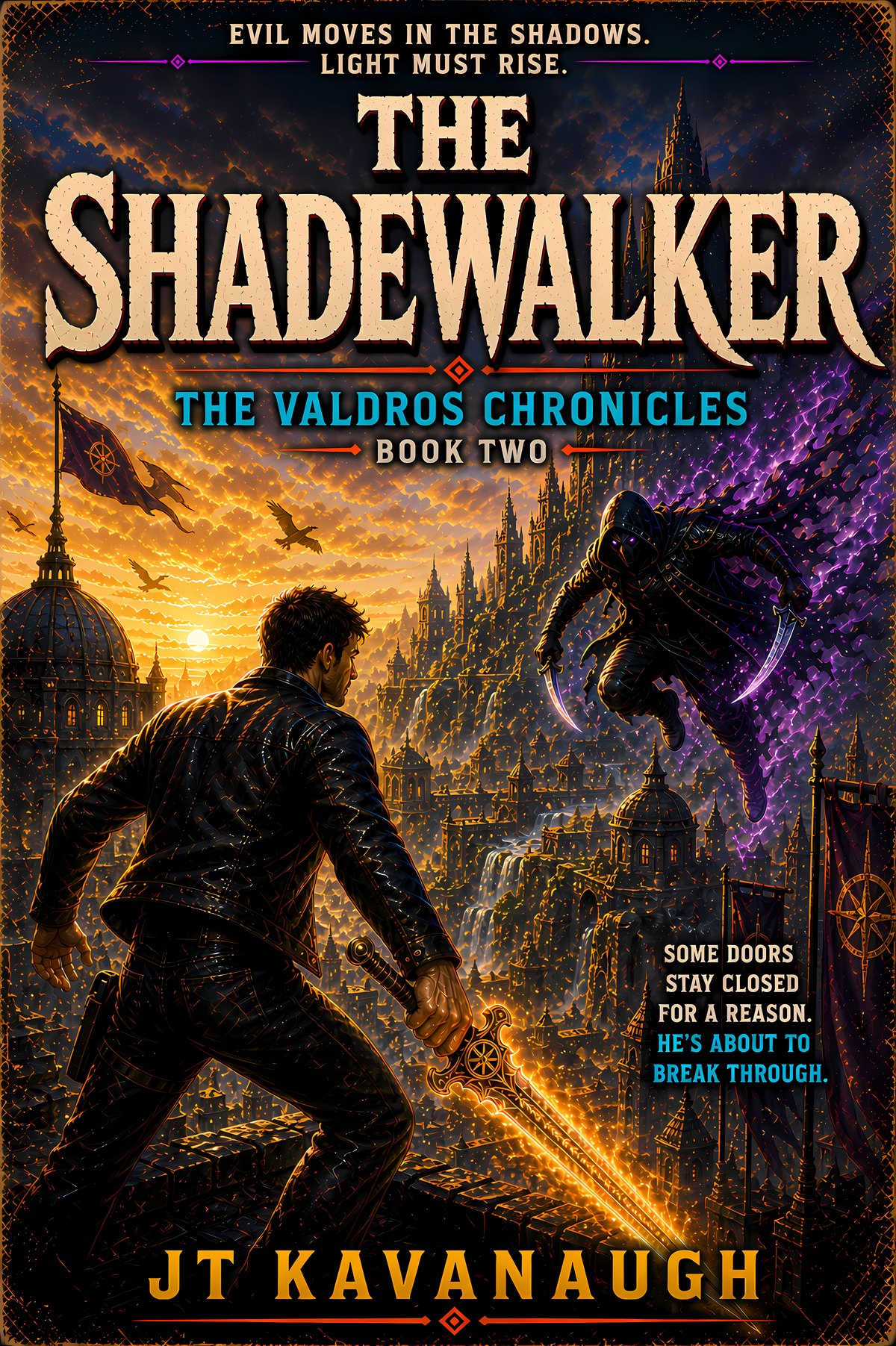
The Shadewalker
Portal Fantasy / Assassin Hunt
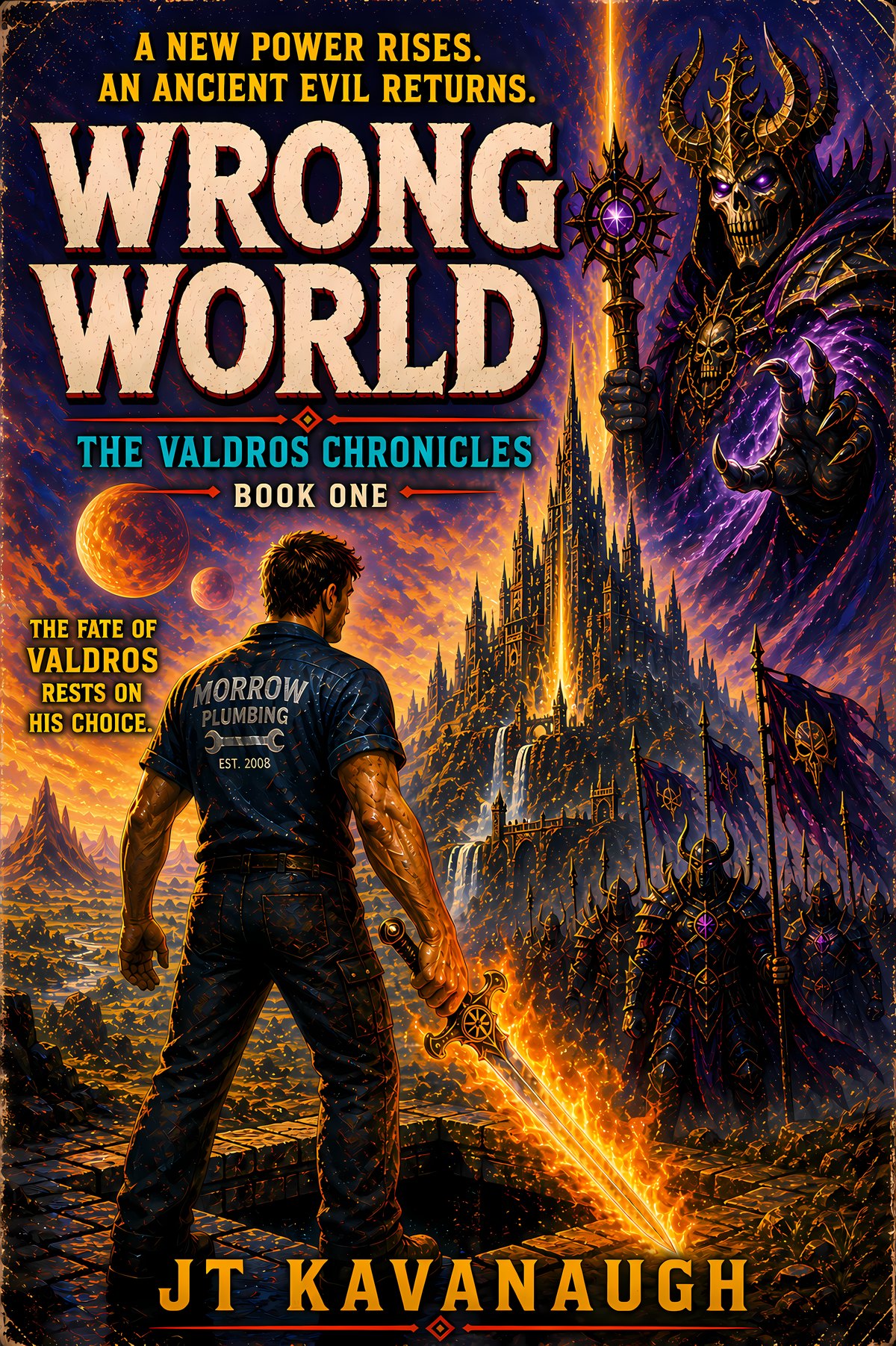
Portal Fantasy / Lost Kingdom
A plumber from Ohio falls into a conquered realm, finds a legendary sword, and gets mistaken for the last heir to a broken throne.
by JT Kavanaugh
reader promise
A plumber from Ohio falls into a conquered realm, finds a legendary sword, and gets mistaken for the last heir to a broken throne.
cover copy
A basement job should have been routine.
Jake Morrow expected a burst pipe, a repair estimate, and maybe enough time to grab lunch before his next appointment.
Instead, the floor opened beneath him.
Now Jake is stranded in Valdros, a conquered realm of ancient citadels, brutal armored soldiers, forbidden power, and skies lit by twin moons. The kingdom has spent twenty years under the rule of the tyrant Drakken, who crushed the royal bloodline and burned resistance from the world one city at a time.
Then Jake finds the sword.
An ancient weapon hidden beside the portal that brought him here. A blade that hums in his hand, blazes with golden light, and marks him as something impossible: the last surviving heir to the throne of Valdros.
Now armies are hunting him. Resistance fighters want to believe in him. And somewhere at the center of the kingdom, a sealed citadel waits for the sword's return.
There's just one problem. Jake is not a legendary warrior.
He's a plumber from Ohio with practical instincts, a stubborn streak, and barely enough training to survive his first real fight.
But while kings and conquerors chase prophecy, Jake approaches problems like a working man: one step, one tool, one impossible situation at a time.
And that may be exactly what this broken world needs.
Wrong World is an action-packed portal fantasy adventure perfect for fans of classic sword-and-sorcery epics, mythic heroes, magical weapons, lost kingdoms, rebellion fantasy, and modern progression fantasy.
sample chapters
Formatted for comfortable reading on desktop and mobile.
The problem with basement jobs was the basements.
Jake Morrow had spent twelve years in the plumbing trade and worked in several hundred basements, enough to sort them into three reliable kinds. Normal meant concrete block, standard utility rough-in, maybe a sump pump grinding away against the water table. Weird meant an outlet wired backward, a load-bearing wall somebody had helpfully removed to make a rec room, or the 1974 newspaper insulation he'd found in Westerville that turned out to be someone's complete archive of moon landing coverage. He'd felt genuinely bad about cutting that out.
Wrong was less a category than a feeling. He couldn't always define it. In a few places over the years, it had hit the moment he stepped off the stairs, a particular awareness that something about the space wasn't right in a way he couldn't immediately articulate. In the end, the feeling had always pointed at something real. Mold in the wall cavity. A support column resting on nothing. A gas line patched with the wrong material thirty years back and holding on stubbornness alone.
This one had the feeling.
The walls were stone rather than poured concrete or block, quarried stone set in courses and fitted the old way with thin, precise mortar that had stayed solid for what looked like a very long time. You didn't see that under houses built in the last hundred years. You barely saw it in the century before. He'd been in a place in Grandview once, a pre-Civil War house on the National Register with a plaque out front, that had a foundation wall like this. He'd remembered it ever since. Mrs. Heller's house was from 1987.
She'd called at eight in the morning, voice careful and level in the way of someone concentrating hard on not alarming anyone. Jake had gotten there by nine — fast for a Tuesday, but he'd had a Dublin cancellation and the drive was easy. He still had three jobs after this one, a pressure issue in Hilliard, a water heater replacement in Worthington, and a rough-in consultation in Westland that should go quickly if the framing was sensible, which in his experience framing rarely was.
She'd offered coffee and apologized for the mess. Jake had taken the coffee, told her it wasn't a mess, told her he'd have a diagnosis inside the hour, and headed down.
Mrs. Heller had followed him as far as the basement door before stopping herself, one hand tight around the mug she had offered him and the other pressed flat to the banister. She had the look he saw often in homeowners when water appeared where water had no business being, as if a house had betrayed them personally. Jake had learned years ago that half of the job was pipes and the other half was telling people one leak did not mean the world had ended.
He gave her the same version of reassurance he always gave when he could honestly do it. He would find the source. He would tell her the cost before he touched anything expensive. She did not need to stand down there with him in three inches of cold water. She had nodded, visibly grateful to be assigned a task as simple as waiting upstairs, and Jake had gone below thinking about fittings and labor and whether he could still make the Hilliard appointment if the diagnosis stayed uncomplicated. The morning had still belonged to him then.
Three inches of cold water covered the stone floor. He found the source inside ten minutes, water pushing up through the joint where the north wall met the floor from pressure outside the foundation. Line break somewhere in the lateral under the yard. Easy diagnosis, a full day to fix. He was pricing the repair in his head when his work light caught the floor at the wrong angle and the seam appeared.
He tilted the lamp. There it was.
Clean edges, cut with intent. A rectangle roughly four feet by three, set into the surrounding stone with a precision that required exceptional skill or exceptional tools, and judging by the mortar, probably both. The seam joints were finer than anything in the wall courses, barely visible, filled with a compound he didn't recognize. There was no lift hardware, pull ring, or visible hinge. Just a perfectly cut outline sitting in the stone floor, submerged under an inch of water.
Jake crouched and pressed his palm flat to the center of it, feeling for airflow out of habit from years of finding hidden things in old structures. He found none. When he pressed harder, nothing shifted.
He stood and looked at it.
Trapdoor. Somebody put a trapdoor under Mrs. Heller's basement. Maybe a pre-existing root cellar. Maybe an access hatch to a decommissioned system. He turned this over and none of it fit. The seam was too precise for anything boring. Whatever this was had been made by someone who knew exactly what they were doing.
He was crouching again with the light angled low across the water's surface, trying to make out any additional detail, when the floor opened.
The rectangle dropped away without groan, mechanism, or warning, clean and deliberate as a door finally doing what it had been built to do. His weight was already forward over the seam. When the floor vanished, he went with it.
He didn't grab anything. There was nothing to grab.
The fall lasted longer than falls are supposed to last.
He had time to think that the floor was definitely broken. Then the sound changed in a way that didn't fit the acoustics of any basement he'd ever been in, the light changed after it, and a vibration arrived that made useful thinking impossible. It wasn't loud so much as enormous, a low frequency he felt in the back of his skull, in his teeth, and behind his sternum all at once, like standing beside a transformer the size of a building.
The light was gold, neither yellow nor white, and it came from everywhere at once, as if the air itself had lit from within.
He hit the ground and it wasn't concrete.
Grass.
Jake lay still and ran the inventory he always ran after unexpected impacts, confirming one thing after another until he was satisfied that his fingers worked, his toes worked, his back was intact, his neck seemed fine, and his vision was clear. He pressed his palms flat to the ground and felt soft, slightly damp earth with something alive in it. When he pushed harder, he found roots, packed soil, real ground.
He opened his eyes.
The sky was wrong in a subtler way than color. The whole dome carried a warm golden tint, like afternoon light seen through barely amber glass, except his body said it should be late morning. He was in a field. Tall grass, a shade of green close to right but half a step off, kept prompting corrections his brain could not make. A treeline stood two hundred feet away. Open land stretched in every direction beyond it.
He sat up and took a breath.
The air was clean and electric, with the charged quality of the moments before a thunderstorm despite the absence of clouds. Beneath that lay something his nose had no category for, faintly metallic and slightly sweet, something that made the air feel fractionally more substantial than air had any business being.
He looked up.
Two moons hung in the daylight sky. The larger one was pale white, fixed above him as if it had always belonged there. The smaller one was rust-red and lower on the horizon. Jake looked at them for three full seconds, the way he looked at things wired wrong before deciding what to do with them. He took in the fact, made sure the fact was a fact, then moved.
He pulled out his phone. No signal. He put it away.
His body had not caught up yet. It was still prepared to solve the basement, still carrying the ordinary Tuesday forward in its muscles. There should have been cold water seeping through his work boots, Mrs. Heller moving around overhead, the sour smell of old concrete and wet insulation. Instead there was grass under his palms and a sky his childhood had never taught him how to read.
He stood and walked back to where he'd come through. He stepped on the spot. Solid earth. He crouched and pressed both palms down into root systems and packed dirt. The ground showed no seam, shimmer, or evidence that anything had ever been there at all.
"Absolutely not," Jake said.
The field did not respond.
He straightened and made a full survey, moving left to right with the same slow care he used in unfamiliar mechanical spaces before touching anything. To the east stood a treeline two hundred feet away, and from behind it came sounds he'd been treating as background noise that were clearly nothing of the kind, several urgent voices in a language he didn't know with deep concussive impacts rolling beneath them, heavy and rhythmic except when they weren't. They had no place in his experience, unlike firearms or engines, but suggested something massive striking something else massive again and again with serious intent.
Getting louder.
To the west lay more open field and a second treeline farther back. North and south were both open, though the southern horizon was broken by a narrow column of gold light driving straight into the sky. It matched the light from the fall closely enough that he assumed they were connected, so he noted it and filed it away.
He looked at the spot where the floor had been. Nothing there.
Jake had been in bad spots before. The one he returned to most often was a crawl space in Clintonville, where the access panel had fallen shut behind him and left him in total dark with no reception. He'd worked his way out by feel over forty-five minutes, scared the whole time and never letting fear stop him. The problem existed. Working it was the only path that led anywhere. He'd come out with a torn jacket, driven home, eaten a very large dinner, and never mentioned it to anyone. The difference was that the crawl space had contained the shape of his life on the other side of it. His truck. His tools. His own front door. This field offered none of those promises.
He made himself stand. Facts could be sorted. Facts could be worked. Work the next fact. Then the next. Feel later, if later insisted.
He needed cover before he needed information, and the treeline was the only place to get either one. That was inconvenient, since the treeline was also where all the sounds were coming from, but inconvenience was most of the job.
He moved toward the trees.
He walked efficiently rather than running, wasting no steps and keeping an eye on the ground ahead for anything that might take an ankle. Twenty feet from the first trees, he saw it.
Low in the grass at the treeline's edge, half-buried in the long growth, something caught the available light and threw it back — warm and gold, here and gone in under a second. Wrong shape for a rock. Right proportions for a hilt.
Behind the treeline, something was losing. Losing fast, losing loud, and losing in his direction.
He bent down.
The glint was a sword.
Jake covered the last few steps and dropped into a crouch at the treeline's edge where the grass grew long and dense. The object was half-buried in the growth, laid flat like someone had placed it deliberately rather than dropped it — the grip and crossguard clear of the grass, the blade hidden under the long growth. He reached down and pulled it free.
The hilt was warm when his palm closed around it. Not from the air. From itself. The grip fit badly and then less badly, as if the blade had made a quick assessment of him and decided to compromise. That thought was ridiculous. It arrived anyway.
Old. Heavy in the right way, not oversized, with the density of quality steel and serious age. The grip was wrapped in something that wasn't leather, darker and finer, still in good condition after what must have been a long time in the ground. The crossguard bore a design of two angular shapes intersecting around something at the center he couldn't make out clearly in this light. A crest he'd never seen before.
He turned the hilt and found the balance — heavier toward the tip, weight forward, clearly designed for movement. He adjusted his grip twice and arrived at something that was still wrong but less wrong. He knew enough to know he was holding a sword incorrectly. He didn't know enough to fix it.
The blade hummed.
The vibration was low rather than loud, moving from the hilt into his palm and up through his forearm like a piece of equipment with something running through it. The sword was warm too, not from the air but from itself, with a heat that had no physical source he could identify. A faint gold light touched the crest on the crossguard for two seconds before fading, leaving only the steady hum behind.
Jake stared at it.
The sword should have been ridiculous in his hand. It belonged in museums, movies, places where metal gleamed under an audience's polish. This one did not gleam so much as endure. Dirt clung in the shallow work around the guard. The wrapping on the grip had darkened where other hands had held it before his. Jake had spent his life around tools, and the first thing he understood about the blade was not that it was beautiful, though it was. It was that somebody had used it. Somebody had trusted it with work that left marks.
That recognition unsettled him more than the moons had. Strange skies could still, in some corner of the mind, be explained away as concussion or shock or a dream with ambitious production values. A tool had purpose. A buried tool had history. A warm tool that seemed to answer his hand suggested obligation, and obligation was harder to dismiss than wonder.
Behind the treeline, ten feet ahead, the undergrowth exploded.
Four soldiers burst through at full sprint, and his brain took inventory in fragments. Dark armor in a design he'd never seen. Two blades already drawn. The coordinated movement of trained professionals pursuing something specific. Farther back through the trees, a fifth figure ran hard in the opposite direction and vanished before Jake could focus on them. That was what the unit had been chasing. Jake was only standing in the way.
He got to his feet slowly. He did not know what raised hands or sudden movement meant here, so he gave them neither. He put the sword between himself and the unit without lifting it aggressively, only making it present. The lead soldier had pulled up in a controlled two-step stop, and the other three had fanned out to either side without a word exchanged between them. Four soldiers, semicircle, ten feet.
The lead soldier looked at Jake's face.
Then his eyes dropped to the sword.
To the crest on the crossguard, specifically. His gaze locked on it with the fixed quality of someone reading something important.
He said something in a language Jake had never heard. The tone wasn't what Jake expected, not the flat threat assessment of a moment ago but something more complicated, layered, as if the problem had just changed categories.
He said something to the others.
The three flanking soldiers went still.
The hum in the blade faded out. The crest went dark. It was just a sword again, old and well-made, held wrong by a man in a Carhartt jacket, and Jake stood in the gap between something that had been about to happen and something that hadn't decided what to do yet.
He understood the gap was temporary. He did not understand what was going to close it, or in which direction. He stood still and waited for more information.
The silence ran for three seconds. Four. One of the flank soldiers said something low — a single word, questioning. The lead soldier answered, clipped and final, and whatever the exchange was it didn't resolve anything. His eyes were still on the crossguard. He hadn't moved. None of them had moved.
Jake took one step to his right. Slow. Lateral — not toward the soldiers, not retreating, just to the right. Testing the gap.
Nobody moved.
He took three more steps, keeping the sword between himself and the unit while tracking the ground in his peripheral vision. Root systems sat just under the surface, ready to take an ankle if he stopped paying attention, and he was not going to fall down in front of four armed soldiers after looking the wrong way.
The lead soldier said something. One word, measured and flat, directed at the unit and not at Jake.
They held.
Jake walked ten steps, then twenty, then forty along the field's edge, keeping his distance, the sword visible, and his footing on the treacherous ground. At the south edge of the field he stepped into the trees and let the treeline swallow him. He looked back once through a gap in the undergrowth. All four soldiers remained in the open. Nobody followed. The lead soldier stood there with that same complicated expression, watching the place where Jake had disappeared into the forest.
Then Jake moved deeper into the trees and it didn't matter.
He navigated by sound.
East held the main engagement, heavier and more sustained than whatever those four had been part of. He moved away from it, angling south and west through the forest, staying close enough to the treeline's edge to keep his bearings while putting enough trees between himself and the open field to have some cover. The canopy broke the already wrong light into fragments. Underfoot, moss hid root systems and damp patches gave unexpectedly beneath his boots. Twice he had to catch himself against a trunk. His work boots were good for a lot of things. Forest navigation in an alien world had not been on the original list.
He stopped behind a wide tree and listened.
Behind him, the forest held only its own sounds and the distant engagement fading east. He checked the ground ahead, checked his grip on the sword, and moved.
He was threading deeper into the trees toward where he estimated the gold pillar lay, somewhere south and ahead, when he heard the footsteps.
A single set of footsteps moved to his right and slightly behind him at an unhurried walking pace. Whoever it was knew exactly where he stood and saw no reason to hurry. This was not pursuit. It was something else.
Jake stopped. He put his back to the nearest trunk and held the sword at what he'd worked out was probably a useful angle, and watched the direction the footsteps were coming from.
They stopped too.
One beat of silence in the forest.
A voice. Low, even. The same language the soldiers had been using, but the register was different — careful, unhurried, something that was closer to a statement than a command.
The footsteps resumed. Slower this time, moving to his right rather than directly at him — circling into his sightline instead of approaching from outside it. He tracked the sound and watched the gap between two trees to his right.
A figure stepped into view.
Older. Sixty-something the way you got to sixty-something from doing hard work for those decades — heavy in the shoulders and chest, substantial, with deep scars on both forearms that caught the filtered light. Battered dark armor, well-maintained but long past new. Gray-streaked beard. Serious face, the resting kind, not the angry kind.
He stood in the gap between two trees and didn't move. His eyes went to the sword in Jake's hand, then to Jake's face. Some long-running calculation in his expression quietly resolved. He looked like a man who had been waiting for a very specific thing and had finally found it.
He said the same words again.
"I don't know what you're saying," Jake said.
The man's gaze returned to the sword for one more beat, then settled on Jake's face. When he spoke again, it was in accented but clear English, with the care of someone who had learned the language rather than grown up in it. "You came through the portal."
"If that's what you call it," Jake said.
He closed his eyes. One second. When he opened them, whatever had been in suspension was gone. "We need to move. They will regroup in minutes."
"Who are you?"
"Talon." He turned to go. "Questions later. We go now."
The sword weighed warm in his hand. The man waited. Beyond the trees, nothing visible moved.
He followed.
The cache was a rock overhang at the base of a low rise. Talon crouched inside it and pulled a pack from a crevice in the back wall and set it down and straightened.
"Now," he said.
Jake didn't move from the entrance. He'd been thinking the whole walk. Twenty minutes of forest and no conversation had given him time to arrive at a conclusion: he didn't know this man. He'd followed a stranger through trees for twenty minutes; the alternative had been standing in an open field with combat sounds coming from the east. That was not trust. That was math.
"The portal back," Jake said. "Where is it."
"There is not one."
"Wrong answer. Try again."
Talon looked at him. "I understand why you want a different answer. I don't have one."
Jake turned and looked back at the trees. The path they'd come from. He could go back that way. He could find the field. He could stand on the spot where the floor had been and press his palms into the roots and packed dirt and wait until something happened.
He already knew nothing would happen. He'd tried it twenty minutes ago. He was trying to find a version of the facts that required less of him.
"How long have you been watching that portal," Jake said.
Talon paused. One beat too long.
Jake turned back. "How long."
"Twenty years."
There it was. The answer that changed the shape of the morning. Not an accident. Not a geological fault line opening at the wrong time. Someone had been watching.
"You knew I was coming."
"We knew the portal existed. We didn't know when it would open. We didn't know who would come through."
"But you had a guess."
Talon said nothing. Which was an answer.
"The sword," Jake said. "You knew the sword was there."
"We knew it had been placed near a portal access point twenty years ago. By someone who hoped it would be found."
"By me."
"By whoever came through carrying the right blood."
Jake looked at the Soulblade in his hand. The crest at the crossguard, warm against his palm. Two hours ago this had been a piece of old metal in wet grass. Now apparently it was an inheritance.
"My father," Jake said.
"Thomas of House Valdros. Yes."
The name hit differently spoken out loud by someone else. Thomas Morrow. His father. Who had left when Jake was eleven and not come back. Who Jake had spent fifteen years constructing a story about — an ordinary man who had made an ordinary bad choice and lived somewhere ordinary with that choice. Not a prince. Not a man from another world who had put a sword near a basement floor and waited to see if his son would fall through it.
"He placed the sword there," Jake said.
"Before he came back."
"He came back here."
"Yes."
"And?"
Talon looked at him steadily. "He died trying to reclaim what Drakken had taken."
The overhang was quiet. Outside, a bird called — three notes, and then nothing.
Jake set the Soulblade against the rock wall. He didn't throw it. He put it down carefully, the way you put down something you might need to pick back up, and he walked to the entrance of the overhang and stood there with his hands at his sides looking at the trees.
"I'm going back," he said.
"The soldiers—"
"I'll go around them."
"Jake." Talon's voice was quiet. "You don't know where around is. You don't know the language. You don't know which direction leads to open country and which leads to a garrison. You have no currency, no papers, no way to explain yourself to anyone you encounter. You have one thing." A pause. "And you just set it against the wall."
Jake stood at the entrance and breathed.
He was not stupid. He could see the shape of the trap — not a trap Talon had made, or not only that, but the trap the facts had made. He was here. The portal was closed. His father was dead. The sword in that cave responded to him and apparently announced him to every soldier trained to watch for it.
Going back meant dying in a forest he didn't know.
He turned around.
"Tell me about Drakken," he said.
"Sit down first."
"Tell me about Drakken."
Talon sat on a rock and looked up at him. "Twenty years ago he took this realm. He had been preparing for years — building forces, making arrangements, placing people in positions that mattered. When he moved it was fast. Your grandfather fell. The royal line was believed broken. Since then Valdros has obeyed him where it had to and survived him where it could."
"How many people."
"Hundreds of thousands under his direct control. More in the outer districts."
"And no one stopped him."
"There was no one to stop him. He moved before there was time to organize resistance. And he has been very careful, since then, to ensure there is nothing for resistance to organize around."
"Nothing like a surviving heir."
"Yes."
Jake retrieved the Soulblade. He had not decided anything. Leaving it on the ground simply seemed worse than holding it.
"The crest," he said. "When the soldiers saw it. Why did they stop."
"The Soulblade is the symbol and instrument of House Valdros. Every Grimborn soldier is trained from their first day to report a sighting immediately. Not engage — report. Drakken wants to know the moment it returns. He wants to be the one who decides what happens next."
"So those four soldiers are reporting me right now."
"Or already have."
Jake turned this over. A man had held an entire kingdom for twenty years. The one thing he was still watching for was Jake. Which meant Jake had arrived carrying exactly the amount of safety of a man who had walked into a room and discovered he was the only thing in it the host wanted.
"He'll try to take the sword."
"If he can."
"And if he can't?"
"Then he'll try to take you out of the question."
"Kill me."
"Yes."
That was cleaner than destiny. Someone Jake had never met wanted him dead over a piece of metal he'd found in wet grass less than two hours ago. He could work with that. It had shape.
"What does the sword open," Jake said.
Talon looked at him.
"You said it was placed near a portal access point. You said Drakken can't reach something without it. What does it open."
"The Citadel of Eternity. At the center of Valdros."
"And the Citadel contains."
"Something called the Primeforce. The accounts disagree on what it can do. They agree Drakken has been trying to reach it for twenty years and cannot."
"Without the sword."
"Without the sword and the blood to wield it."
Jake turned the Soulblade over in his hands. In the filtered light of the overhang the crest was just a design worked into old metal. Nothing that looked like a key. Nothing that looked like the reason a man had held a kingdom hostage for two decades.
The blade hummed.
Low. Steady. Not threatening — something else. Like confirmation.
"It does that," Jake said.
"I know."
"What does it mean."
"It means it knows you," Talon said. "Whatever else the Soulblade is, it has been waiting a long time to be held by the right person."
"I'm not the right person. I'm a plumber from Columbus."
"Those are not mutually exclusive."
Jake stared at the crest. "I don't belong to a sword."
"No. The sword belongs to your house. That's a different thing."
Rain started outside the overhang. Light at first, ticking through the leaves. Jake watched it and thought about the four soldiers in the field, about a man in a tower who had spent twenty years waiting, about a man named Thomas Morrow who had put a weapon near a basement floor and died before he could see if it worked.
"You knew him," Jake said. "My father."
"Yes."
"For how long."
"From when he was young. He was a prince, then a man in exile, then a man trying to find a way home." Talon looked at the rain. "He talked about you."
Jake had no good response to that. He'd spent fifteen years being angry at his father for leaving. The anger had been useful — he'd built things on top of it. Now someone was telling him the man had talked about him from another world, and the anger didn't know where to go.
"What did he say."
"That you were practical. That you approached problems the way a craftsman approached them. He was proud of that."
"He left when I was eleven."
"I know."
"He didn't know what I was like at twenty-three."
"He knew what he had built in eleven years. He hoped it would be enough." Talon met his eyes. "Looking at you, I think it is."
Jake said nothing. That was too large a thing to hold right now. He would put it somewhere and come back to it.
"We need to move," Talon said. "The city is most of a night from here. There are people there who can help you better than I can alone."
"Help me do what."
"Survive long enough to matter."
It wasn't inspiration. It was a plumber's kind of answer — the next step that led somewhere instead of nowhere.
"You're going to explain more while we walk," Jake said.
"Yes."
"All of it. Not just the parts you've decided I can handle."
Talon considered this with the patience of a man who had been careful about information for a long time.
"Most of it," he said.
It was not reassuring. Jake suspected it was honest. For now that was close enough.
They left the cache. Through a break in the canopy the horizon flashed gold — the column of light, still there, marking something sealed and waiting.
Jake had not decided to trust Talon. He had decided to walk in the same direction. The motions looked similar from the outside.
Talon talked while they walked, which was what Jake had negotiated for.
Jake returned to the questions he'd been carrying since the cache, beginning with the gold column. The Citadel of Eternity stood at the geographic center of Valdros and had been radiating visible light for twenty years as a side effect of the seal. It wasn't a signal fire. It was a twenty-year side effect of being locked against everyone who lacked the right blood and the right sword. Jake updated his mental map and moved to the next question.
The Reach. The territory they were moving through — wild lands between the cities, mostly ungoverned, useful for people who needed to travel without being seen. Also useful for the other kind of people who preferred not to be seen. Jake asked what kind. Talon said to keep his voice down and watch the northern treeline for the next ten minutes.
They watched the northern treeline. Nothing came from it. Jake filed this under other kind and kept walking.
"My father," he said, as the path descended into a creek bed and they picked their way across. "He came of age here. Trained to rule."
"He did."
"And then Drakken happened."
"And then Drakken happened."
"Fast? Slow?"
Talon's pause was brief. "Faster than anyone believed possible. Drakken had been building for years. When he moved, there was almost nothing to stop him."
"And my father's plan was to get the kid out, go back, and improvise."
"He didn't get to the improvising."
Jake's work boots were wet from the creek crossing. His shoulders ached in the way that suggested the cache's stone floor had given him roughly no useful rest. He shifted the Soulblade, tried the grip Talon had shown him — low on the handle, thumb laid along the flat, weight absorbed at the heel of the palm — and found it slightly better than it had been yesterday. He supposed that counted as progress.
"Who knew about me?" he asked. "Before last night."
"Myself. A handful I trusted, most of whom are dead. Drakken suspected a portal had been used to hide the heir. He could never confirm it."
"Until last night."
"Until last night."
Jake worked through the geometry of this. Drakken had spent twenty years searching for something he'd only suspected existed. Jake had been found in under an hour. He tried to decide how that made him feel and concluded he'd get to it later, after being chased didn't feel quite so immediate.
"The Soulblade," he said. "If Drakken can't use it — can't someone put it somewhere? A vault? Somewhere he can't get to it?"
"He has been looking for it for twenty years."
"So that would be no."
"That would be no."
The path broke out of the trees, ran along the top of a low ridge, and Jake stopped.
Below the ridge, in the gray early light, Varethon City was waking up.
He'd expected walls. Towers, maybe. Something that would resolve into a shape he'd seen in movies and let him move on. What was below him refused any single category.
The city had been built on top of itself across what looked like several distinct geological eras, each layer of architecture disagreeing with the ones above and below it. At the bottom lay old foundational stone, the kind that predated whatever came after and had been left alone; removing it would mean removing everything else. Above that rose metal frameworks, the bones of older structures pulled apart for materials and never reassembled, their original purpose gone but their skeletons still useful as scaffolding for the buildings woven through them. Higher still crowded the working city, buildings packed together with the cheerful density of people who had stopped asking whether there was room. Elevated aqueducts carried actual water above the rooflines, their engineering showing its age and not caring.
And then the gaps. Several of them, visible from the ridge — sections where things had been and weren't anymore, scraped down to foundation stone. The buildings around each gap had the look of structures that had been close to something terrible and had learned to keep going regardless.
Drakken's recent raids, written into the geography.
"How many people," he said.
"Half a million on a good census. Less now."
The descent into Varethon took longer than it looked from the ridge. Nearer in, Jake saw clotheslines strung between balconies, repaired roof tiles in seven mismatched colors, shrine niches set into corners where the faces had been chiseled away but offerings still appeared beneath them. He saw a woman pour a bucket of gray water into a gutter and glance twice toward a pair of dark-armored soldiers before returning indoors. He saw children playing some chasing game in a lane stop without being told when a patrol crossed the mouth of it, the way children learned traffic in cities where the dangerous thing had a uniform.
None of it matched the clean grandeur he had expected from the word kingdom. Varethon was too patched, too crowded, too insistently alive. It had not preserved itself for his arrival. People still needed breakfast, repairs, gossip, somewhere to sleep, somewhere to sell onions, even under occupation. That ordinariness struck him harder than any tower could have. If Drakken burned districts over Jake's arrival, he would not be burning a backdrop. He would be burning all of this.
At the first checkpoint inside the city, Talon changed his posture before the soldiers even looked their way. It was subtle, only a lowering of the head and a fraction less certainty in the shoulders, but Jake noticed. In the forest, Talon had moved like a man who expected the ground to respect him. Here he did it by becoming older.
The Grimborn at the checkpoint inspected packs, faces, blades. One of them lingered on Jake longer than the others, gaze catching on the Carhartt jacket, the shape of him, perhaps only the foreignness he could not fully hide. Talon answered a question before Jake understood it had been asked. The soldier's attention moved on.
They were three streets away before Jake said, "What did he ask."
"Whether you were kin."
"And you said."
"That you were my sister's son from a village too small to matter."
"You have a sister."
"No."
Jake glanced back once. The checkpoint had already swallowed the next group of people. Nobody there looked surprised to be searched on the way to buy bread. That stayed with him more than panic would have. Fear had been worn smooth by repetition until people carried it like another coin in the pocket.
"More than enough to hide one Ohio plumber for a few days," Talon said.
They went down the ridge.
The lower market wasn't a place; it was a condition.
Every surface sold something. The stalls had accumulated over years — awnings extended, counters added, lean-tos constructed off lean-tos — until the original structure was two layers down and had made peace with its situation. The crowd moved with the dense, frictionless efficiency of people who had been navigating the same space for generations and had stopped noticing they were doing it.
Jake smelled smoke, cooking meat, something sweetly fermented, wet stone, an animal he had no category for, and beneath it all the electric edge that had been in the air since he'd landed. He heard negotiation in at least three languages, children, a mechanical sound laboring somewhere above the rooflines, an argument that was clearly about money, and a hollow bell that rang three times before falling silent.
"Head down," Talon said, without turning.
The Carhartt jacket was doing its best to look unremarkable and not quite managing it. The Soulblade was wrapped beneath his other arm, jacket pulled over, but the crossguard made a shape against the fabric that nothing innocent would make.
They moved at Talon's pace, neither hurried nor leisurely, the pace of people going somewhere specific. Jake tracked exits as they went, marking two alleys to the left, the main lane opening right, a staircase up to the elevated walkway, and another descending at the far end. Old habit. He'd always noted exits.
Talon turned right at a junction and the crowd thinned, the lane narrower, walls higher on both sides. Jake was two steps behind him when he heard it — a voice cutting across the market noise from above and behind. Loud, urgent, repeating.
He looked back.
On the elevated walkway above the lane they'd just left, a Grimborn soldier in dark armor pointed down at the crowd below while passing information to someone outside Jake's sightline. The soldier's head turned mid-sentence, and his eyes swept the lane beneath him.
They stopped on Jake.
On the angle the Soulblade made against the jacket, specifically. The shape that didn't fit.
Half a second of eye contact.
Jake faced forward and kept walking.
"Talon."
"I know." Not changing pace, already adjusting — turning at the next junction, into a lane that ran downhill between tall buildings. "Don't run."
"I know."
"You're thinking about it."
"I know," Jake said. He did not run.
Behind him came the sound of someone dropping from the elevated walkway to the lower level. One soldier, not a squad. He was checking something out, not yet a system-wide problem but about to become one.
"How far," Jake said.
"One street. The green door."
Twenty meters. The lane bent ahead and the door wasn't visible yet. Behind him the soldier was pushing through the crowd — politely at first, then less so.
Around the bend stood a row of low doors, and at the end waited green, genuinely green, the color of something painted and exactly the color he was looking for.
Talon reached it. Three knocks in a pattern. Jake was one step behind, half-turned, watching the bend.
The soldier came around it at a jog, saw Jake, stopped, and reached for his belt.
Jake stepped through the opening door.
It closed.
Dark inside. Stone floor, low ceiling, the smell of oil and old wood. A line of warmer light under an interior door.
"He'll report," Jake said.
"Already has." Talon, even. "We have some hours. Fewer if he got a good look."
"He got a look."
"Then fewer hours." Talon's hand went to the interior door. "Come in."
Jake stood for a moment with his back to the closed street door. He thought about the gaps in the city's layout — the foundation stone, the buildings that had kept going regardless. He thought about half a million people, minus whatever Drakken's raids had taken, having their morning out there.
"All right," he said.
He followed Talon through the door.
The market noise through the street door continued at its normal pitch — no alarm, no burst of running feet, nothing cutting through the morning rhythm. Whatever the soldier had chosen to do, he hadn't chosen to knock. That ordinary noise outside made the room behind the green door feel stranger, as if danger in Varethon had learned to coexist politely with breakfast.
"Reporting first," Talon said quietly. "Not acting alone."
"How long does that take him?"
"Nearest post is four streets east. Twenty minutes to report and come back with authorization." He turned to the interior door. "We don't have twenty minutes to spare."
He knocked — three knocks, intervals shorter than the pattern at the street door. The light showing at the threshold went dark briefly. Then the door opened.
What was in front of him was a workshop.
Three long worktables ran the length of the space, covered in maps and weapons at various stages of maintenance. Shelves along the far wall with everything on them arranged by someone who had real opinions about arrangement. A rack of armor to the right — two full sets plus spare pieces, all in noticeably better condition than Talon's. A shuttered window on the north wall, cracked open two fingers' worth, thin strips of early light falling across the nearest table and catching a blade that had been mid-sharpening when they arrived.
The woman standing over it had not been surprised by the door opening.
She had heard them through the door. Her eyes were already on Talon before Jake followed him inside.
Short dark hair. Built from years of actual work rather than performed strength, with the real kind settled into her shoulders and back. Twin blades rested on her hips with the ease of things she had stopped consciously registering. Late twenties at the outside. As she assessed Jake, her expression carried no heat, only the problem of evidence refusing to be convenient.
She was the first person he had seen in Valdros who looked at the Soulblade and then at him as if the second mattered more than the first.
Talon gave her the short version. She listened without interrupting. That, Jake noted, was either how she always worked or how she worked when she'd already made some decisions and was filling in the rest.
"Does he speak Valdrosian?" she said.
"Not yet."
"Has he trained?"
"Not yet."
"Has he used the blade at all?"
"He held it in the field. Four Grimborn scouts stopped advancing."
"I can answer questions myself," Jake said.
They both looked at him.
"I don't speak the language," Jake said. "I haven't trained. I've been in this world for one night and most of it was walking through a forest with Talon. I am not what you were hoping for." He looked at Lyra. "What do you need to know?"
Her expression shifted — not warmer, but into a more operational mode. "Draw the blade," she said.
Jake drew the blade.
One night of carrying it had given him something. The draw still was not clean, his grip on the initial pull slightly off, but the blade came out, his hand found its position on the hilt, and the Soulblade settled before him at a roughly horizontal angle.
The crest caught the thin morning light.
Lyra came around the worktable to about four feet away. She looked at the blade rather than at Jake — reading the crest specifically, the way a mechanic examined a joint rather than the person who'd made it.
"It's not glowing," she said.
"It does that sometimes. Not on command."
"When does it?"
"When it decides to. I'm not running it."
She looked at him directly. "Which end is dangerous."
Jake looked at the blade. "The edge."
"Mm." Not approval — a neutral acknowledgment that at least one person in the room had been paying attention. She stepped back. "The crest is real. Reproductions are always off at the lower join; this one is not. And if the blade has responded three confirmed times—" She looked at Talon. "Three."
"This is him," Talon said.
"He looks like a plumber."
"He is a plumber."
She set down the whetstone and picked up a cloth and dried her hands. "Talon," she said. His name not as a greeting but as a position statement.
"Lyra," Talon said. With the patience of a man who had been anticipating exactly this sentence.
There was a pause after Talon finished the short version, not long enough to become silence but long enough for Jake to understand that Lyra was recomputing more than patrol routes. Her eyes moved once around the room she had built, across the shelves, the worktables, the armor rack, and returned to him. He knew that look from contractors deciding whether to cut open a finished wall. The answer might be necessary. Necessary did not mean free.
"If the Grimborn take this place," she said, "they do not only take the weapons. They take names. Routes. Habits. Every person who has come through this door in the last year becomes more vulnerable if I choose badly once."
"Then do not choose me for the sword," Jake said.
That made Talon glance at him. Lyra did not. "I am not."
"Good. I would rather know the actual terms."
Something in her posture shifted, almost too small to see. "The actual terms are that if you stay, you learn quickly, listen when you do not know enough to argue, and do not mistake being necessary for being exempt."
"Those are terms I can work with."
"Most men say that before instruction begins."
Jake glanced at the blade in his hand. "Then I suppose you get to find out whether I am most men."
"Mm." She showed him the grip. "Show me how you're holding it."
Jake adjusted — low on the handle, thumb along the flat, elbow in, weight to the heel of the palm. The blade went from something he was managing to something he was holding.
Talon, somewhere behind him, made a sound that wasn't quite a comment.
Lyra watched Jake's hands for a moment. "Can he fight."
"He'll learn."
"That's not what I asked."
"No," Talon said. "He cannot fight."
She set the cloth down. "You know what you're asking me."
"I'm not asking you anything," Jake said. "Talon brought me here. If you want me to leave, say so."
"I don't want you to leave." Said cleanly, like a decision already reached. "I want you to understand why I'm not sold. A man shows up with a real royal blade and a bloodline claim I can't independently verify. The Grimborn know he's in this city. My location has maybe thirty-six hours before it's compromised, and after that I need to move." She looked at him steadily. "I need to know whether I'm moving with a liability or an asset."
He thought about one night in this world, about the gaps in the city's layout and the foundations where things had been, about a scout in the lower market who had gotten a good look at a crossguard making the wrong shape under a jacket.
"I don't know yet," he said. "I know I can use the blade and you can't. I also know I'm the reason the scout posted. Both of those things are true at the same time."
The line of Lyra's mouth shifted toward something almost like a smile before she controlled it. She looked at Talon. "He reasons clearly."
"When he applies it outward," Talon said.
She looked back at Jake. "Back room. There's a cot." She was already turning back to the worktable. "Don't thank me. Back room. Don't touch anything."
Jake went to the back room. The cot was narrow and hard and covered in something that scratched, and it was the best horizontal surface he'd encountered since Columbus. He set the Soulblade against the wall where it wouldn't fall. He took off his jacket. He lay down.
He was asleep before the thought he'd started on the way down reached its conclusion.
recommendation loop
Portal Fantasy / Assassin Hunt
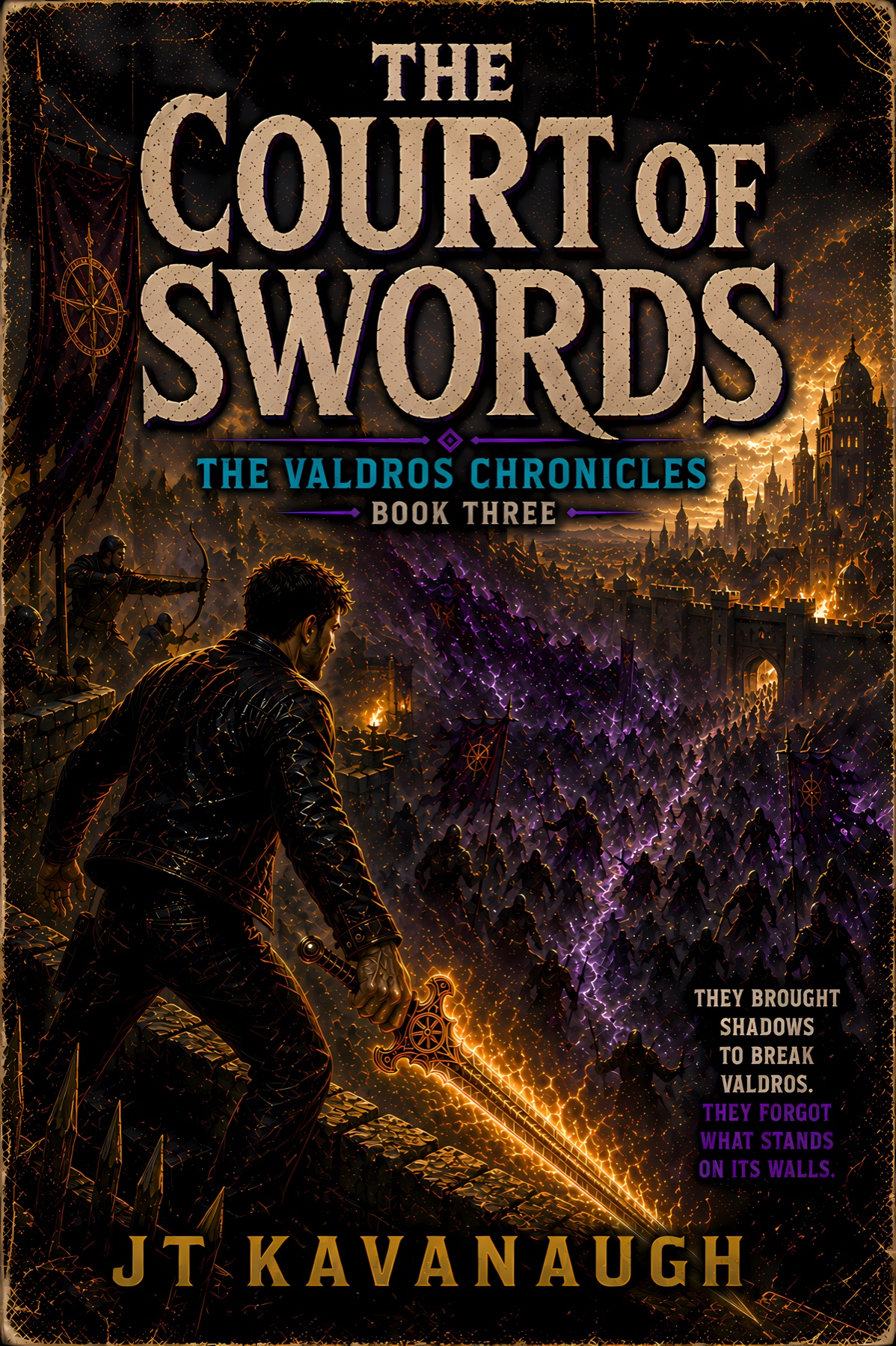
Portal Fantasy / Siege of Valdros
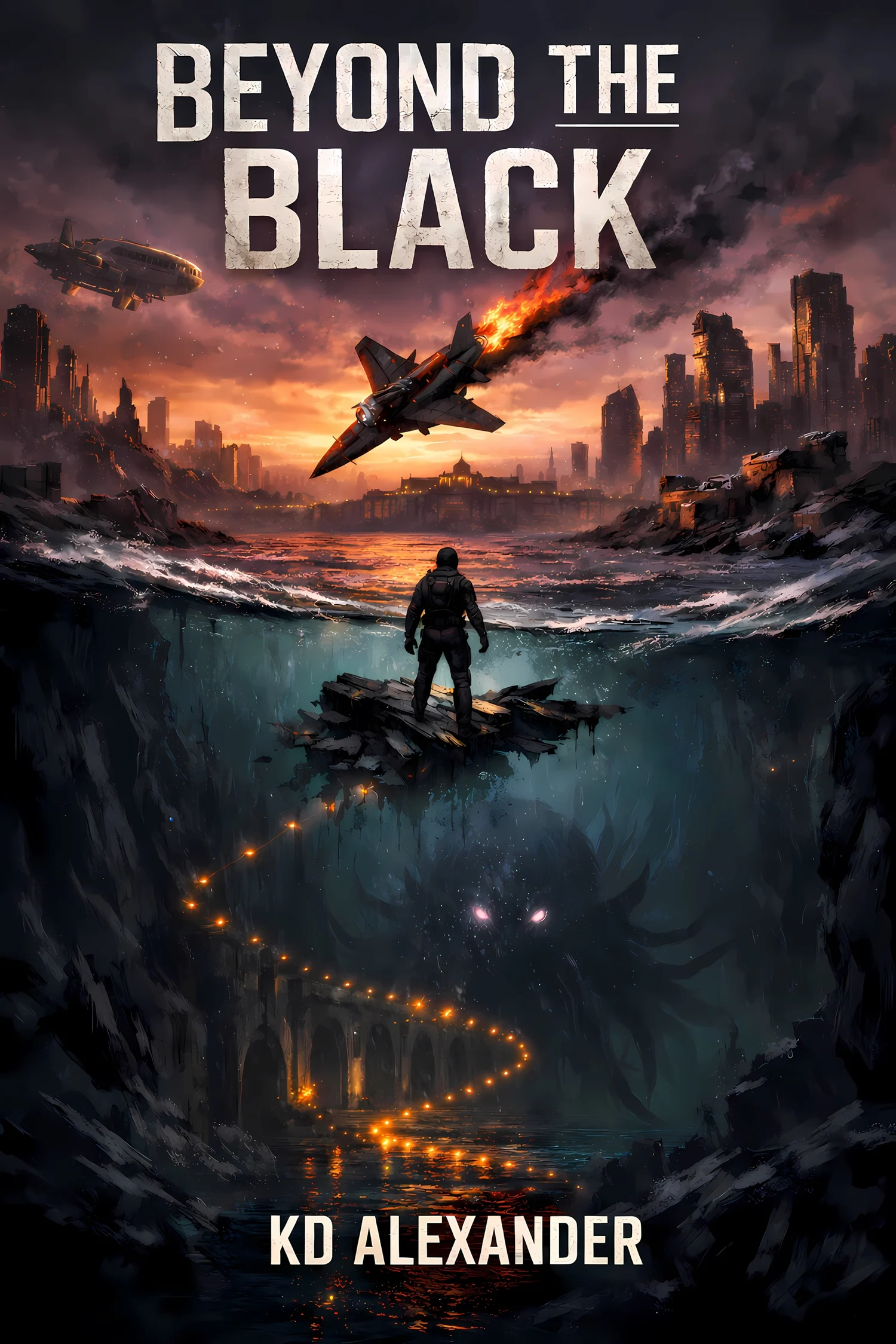
Post-Apocalyptic Science Fantasy